

“Quick answer: Small medical practices face five core challenges: rising operating costs, claim denials, insurance verification gaps, slow follow-up on aging accounts, and staffing strain. Each one feeds the next, so a missed eligibility check becomes a denied claim becomes an uncollected balance. Fixing them in order is what protects cash flow.”
Running a small practice means wearing every hat at once. You see patients, manage staff, handle compliance, and somewhere in between, you try to make sure the money actually comes in.
That last part is where most small practices quietly lose ground. The challenges for small businesses in the healthcare industry rarely show up as one dramatic problem. They build slowly through missed eligibility checks, denied claims, and staff stretched too thin to follow up.
Left alone, those small leaks turn into serious cash flow gaps that decide whether a practice stays open.
Key Takeaways
- Rising costs and flat reimbursement hit small practices hardest because they lack cash reserves.
- Most billing problems follow a chain, where one weak step causes the next.
- Insurance verification at scheduling stops the largest share of preventable denials.
- Some challenges need only a workflow change, while others need technology support.
- Automation lets a small team do more without adding headcount.
Why is the Financial Squeeze Worst for Small Practices?
Money pressure is the backdrop for almost every other problem a small practice faces. It is one of the biggest challenges for small businesses in the healthcare industry these days.
According to a July 2025 MGMA Stat poll, average year-to-date operating expenses for medical groups climbed about 11% in 2025 compared to 2024.
When costs rise that fast and reimbursement stays flat or drops, every dollar you fail to collect hurts more than it used to. Smaller practices feel this sharpest because they don’t have the cash reserves that larger groups use to ride out a slow month.
The problem is, financial pressures don’t remain constant. If no one is dedicated to bill claims, claims slow to work. If claims are going slower, denials accumulate and aging accounts increase. The entire revenue cycle begins to take a wobble and the practice begins to respond to issues rather than anticipate them. This is how good systems are designed to fail.
What Causes Revenue Cycle Problems in Small Practices?
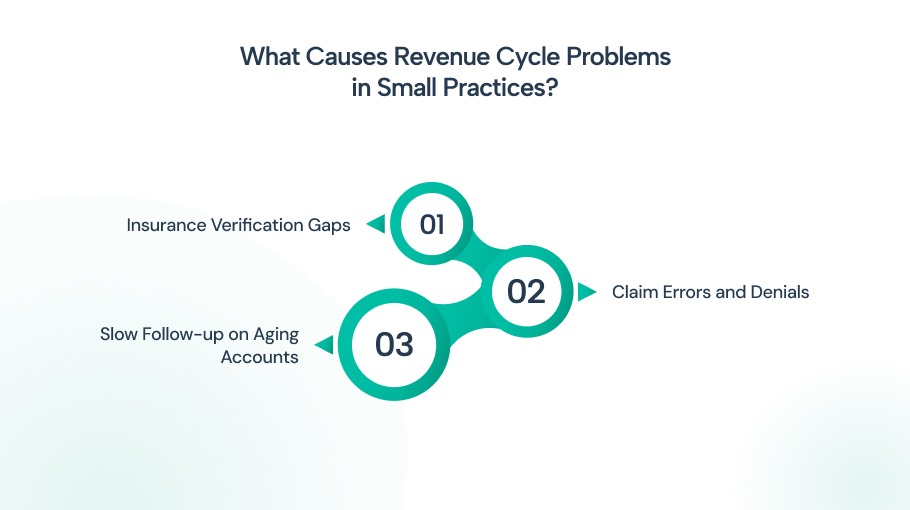
Revenue cycle management is the full process of getting paid, from verifying a patient’s coverage to collecting the final balance. Most billing problems trace back to a few weak points in that process that repeat across nearly every small practice. Fixing them in order matters, because each one feeds the next.
Insurance Verification Gaps
Eligibility errors are one of the most common reasons claims get denied, and they’re almost always preventable. When front-desk staff are busy checking in patients, verifying coverage gets rushed or skipped.
The claim goes out, the payer rejects it weeks later, and now someone has to rework it. Strong insurance verification at the point of scheduling catches these problems before a single service is billed, which keeps denials from ever starting.
Claim Errors and Denials
Denials cost you money, and the amount of practice manager time you invest in chasing them is even worse than you’d think. First claim is paid, for a clean claim, it takes days.
A denied claim may require several weeks of calls, resubmissions and appeals to get it resolved. When you catch errors and documentation before you submit them, you’re more likely to get them accepted on the first try and your employees more likely to be working on real money transactions.
Slow Follow-up on Aging Accounts
After 30 days a claim remains unpaid, the likelihood of collecting it begins to wane. Often small practices do not have the staff to pursue all of the old accounts, and balances sit there quietly.
A system that raises the flag as soon as an account falls behind provides you with a fighting chance to get it back before the deadline.
How Does Better Workflow Improve Medical Billing?
Better claims processing isn’t about working harder. It’s about catching problems earlier so fewer of them reach the expensive stage. When a platform scrubs claims against payer rules before submission, flags missing information, and routes denials straight to the right person, your team spends less time fixing errors and more time on patients.
This is where CureAR fits into the picture. The platform uses AI to handle the repetitive parts of the revenue cycle management process, the eligibility checks, the claim scrubbing, and the denial routing, so your staff isn’t buried in manual work.
Honestly, the difference shows up fastest in the numbers most providers watch every week: days in accounts receivable and clean claim rate. When those two improve, cash flow follows close behind.
There’s a fair question here about whether automation can really replace experienced billing judgment. It can’t, fully. Workflow automation handles the repetitive parts of claims processing. It takes the routine load off your team so the people you have can focus on the cases that genuinely need a human eye.
How Does Staffing Strain Affect Small Practices?
Billing and coding roles are hard to fill and harder to keep, especially at a small practice that can’t match hospital pay. When one person handles too much, mistakes creep in and morale drops.
Automating repetitive tasks doesn’t eliminate the need for good people, but it lets a lean team do more without burning out. That stability matters because every time a trained biller leaves, your practice loses speed and accuracy while you scramble to backfill.
Workflow tools that reduce manual entry also make onboarding faster. A new hire who learns a guided system gets productive sooner than one thrown into a messy manual process, which softens the blow when turnover does happen.
Which Challenges Need Technology, and Which Need Workflow Fixes?
Not every problem needs new technology, and not every problem can be fixed with workflow alone. The table below sorts common challenges by what actually solves them.
| Challenge | Quick Workflow Fix | Needs Technology Support |
| Eligibility errors | Verify coverage at scheduling | Automated real-time eligibility checks |
| Claim denials | Double-check coding before sending | Rules-based claim scrubbing |
| Aging accounts | Set a follow-up schedule | Automated aging alerts and routing |
| Staff burnout | Redistribute tasks fairly | Automation of repetitive data entry |
| Patient collections | Clear cost estimates upfront | Online payment portals and plans |
Most small practices need a mix of both columns. Starting with the workflow fixes costs
nothing and buys you breathing room while you evaluate which technology investments will pay off. Practice workflow optimization works best when you address the simple things first, then layer in automation where the manual load is heaviest.
Bringing it Together
The challenges for small businesses in the healthcare industry are real, but they’re rarely as random as they feel in the daily grind. They tend to follow a chain, from a missed eligibility check to a denied claim to an aging account that never gets collected.
Break that chain at the start, and the rest gets easier. Tools like medical billing automation give a small team the reach of a much larger one, which is what keeps an independent practice independent.
If denials and slow collections are wearing your staff down, take an honest look at where your revenue cycle leaks first, then decide which fixes earn their place.
Frequently Asked Questions
Rising operating costs paired with flat or shrinking reimbursement are the biggest financial challenge.
Small practices feel it most because they lack the reserves to absorb a slow stretch. Improving collection speed and cutting denials is often the fastest way to protect cash flow without raising prices.
Poor verification sends claims out with wrong or expired plan details, which payers reject. Your team then has to rework each one by hand, weeks after the visit. Checking eligibility at the time of scheduling stops most of these denials before they ever happen.
Most small practices find the cost of denied and delayed claims outweighs the cost of a good system.
When automation lifts your clean claim rate and shortens days in accounts receivable, the recovered revenue often covers the investment. The sharper question is what slow collections are already costing you.
No, automation handles repetitive tasks like eligibility checks and claim scrubbing, not judgment calls. It frees your team for the work that needs a human eye. Most practices keep their staff and simply get more done with the people they already have.
Start with insurance verification, since eligibility errors cause so many downstream denials. From there, tighten your claim review process and set a firm follow-up schedule for aging accounts. Fixing these in order keeps each problem from feeding the next.