
Gastroenterology is one of the most financially complex specialties in medicine. GI practices deal with high-volume procedure coding, strict medical necessity rules, modifier-dependent reimbursements, and payer policies that change faster than most billing teams can track.
Choosing the right gastroenterology billing software isn’t a minor administrative decision. It’s a revenue decision, and getting it wrong costs real money every month.
According to research published in The American Journal of Gastroenterology, inflation-adjusted reimbursement for common GI procedures declined by 33% between 2007 and 2022.
That’s a striking figure, and it means every denied claim or undercoded encounter now cuts deeper than it did a decade ago. On top of shrinking reimbursement, denial rates across commercial payers have been climbing. A 2024 HFMA analysis found initial denial rates reached nearly 12% by the end of 2023 and have continued rising since.
This guide breaks down what makes medical billing software for gastroenterology practices different from general platforms, which features matter most, and how leading options compare on the capabilities that GI billing actually demands.
Comparing Leading Platforms for GI Clinics
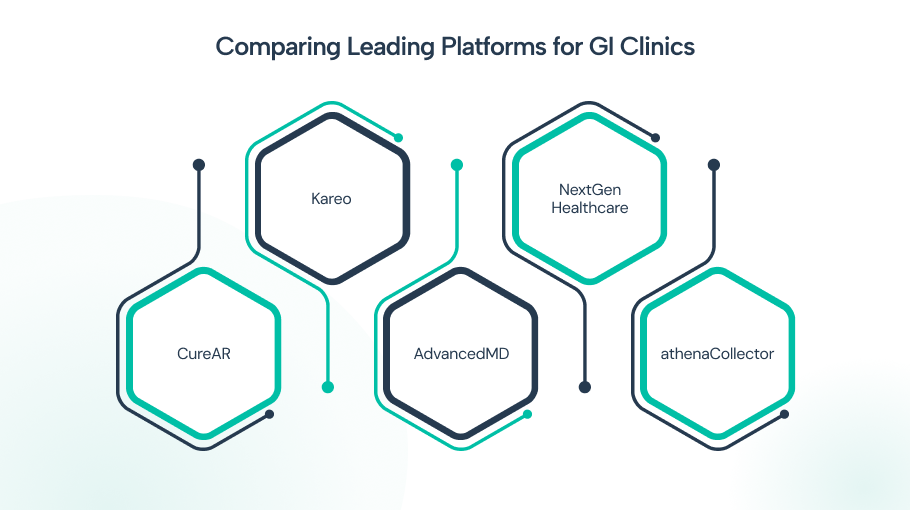
Choosing gastroenterology billing software for GI clinics comes down to how well a platform handles the specific coding, integration, and analytics demands of GI work.
Here’s how the five leading options compare:
1. CureAR
CureAR is built around AI-driven claim accuracy, which makes it a strong fit for GI practices dealing with high denial rates on procedure-heavy claims. The platform identifies coding mismatches and modifier gaps in real time during charge capture, before a claim reaches the clearinghouse. That’s a meaningful distinction from systems that only flag errors after the claim is built.
Integration: CureAR supports broad EHR compatibility, which matters for GI practices using a range of clinical systems. It also offers both a software platform and a managed RCM service, so practices can choose how much to handle in-house.
Analytics: Denial reporting goes to the payer level, allowing billing teams to spot patterns by payer and procedure code rather than reviewing denials claim by claim.
2. Kareo
Kareo suits smaller, independent GI practices that are transitioning away from manual billing or outsourced services. Its setup is simple and includes a native EHR, which reduces the number of vendor relationships a small practice has to manage.
Integration: Kareo’s integrated PM and EHR environment keeps charge capture and billing in one place, which reduces re-entry errors for practices without a dedicated IT team.
Analytics: Reporting is standard rather than specialty-configured. Practices with complex GI coding patterns may find the denial analytics less granular than they need over time.
3. AdvancedMD
AdvancedMD works well for multi-provider GI groups that want configurable workflows without the overhead of an enterprise system. The platform allows practices to build custom claim rules, which can be tuned to GI-specific code pairs and modifier logic.
Integration: AdvancedMD offers an integrated PM and EHR with workflow automation across scheduling, documentation, and billing. Groups running multiple providers benefit from the centralized workflow controls.
Analytics: The analytics dashboard is solid for tracking denial trends and AR aging. Groups that do regular performance reviews will find it usable without needing additional reporting tools.
4. NextGen Healthcare
NextGen is built for larger GI practices and multi-specialty groups that need specialty-configurable claim edits and enterprise-level integration. It handles the coding complexity of high-volume GI billing well, including procedure-intensive encounters that require multiple code lines and modifier stacking.
Integration: NextGen connects to enterprise EHR environments and supports complex, multi-site data flows. For GI groups that have grown through acquisition or operate across several locations, that infrastructure matters.
Analytics: Reporting is advanced, with the ability to benchmark performance across providers and locations. Practices under margin pressure from declining GI reimbursements can use that data to identify exactly where revenue is leaking.
5. athenaCollector
athenaCollector’s value proposition is tied to its network. Because it operates across a large number of practices, it updates claim rules based on real payer behavior across that network, which means GI-specific denial patterns get captured and corrected faster than in siloed systems.
Integration: athenaCollector connects to the broader athenahealth ecosystem, making it a natural fit for practices already using athena’s EHR or patient engagement tools.
Analytics: Benchmarking is a strength. Practices can compare their denial rates and collection performance against similar GI groups on the network, which gives context that internal reports alone can’t provide.
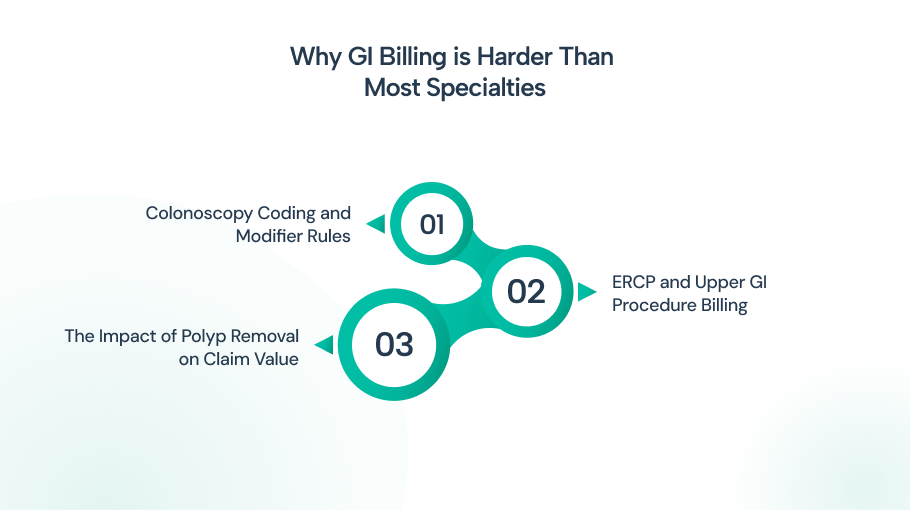
Why GI Billing is Harder Than Most Specialties
Gastroenterology generates billing complexity that generic platforms aren’t built to handle well. A single colonoscopy with a polyp removal and biopsy can require multiple CPT codes, the right modifiers, and documentation that justifies every line on the claim. Get one element wrong, and the whole claim comes back.
Colonoscopy Coding and Modifier Rules
Colonoscopy claims are among the most frequently audited in outpatient medicine. CPT codes for diagnostic versus therapeutic procedures, split billing when the procedure crosses the hepatic flexure, and modifier 33 for preventive versus diagnostic classifications all create layered decision points before a claim even reaches the clearinghouse.
The software you choose must support modifier prompting at the point of claim creation, not as an afterthought. Systems that don’t embed GI-specific coding logic into the workflow push that complexity onto your billing staff, which is where errors and missed reimbursements happen.
ERCP and Upper GI Procedure Billing
Endoscopic retrograde cholangiopancreatography procedures carry high reimbursement and equally high scrutiny. ERCP billing requires precise documentation of the procedure’s scope, concurrent diagnoses, and whether additional interventions occurred. Payers, particularly Medicare Advantage plans, routinely request records before paying these claims.
Software that integrates clinical documentation with billing workflows, rather than treating them as separate systems, reduces the friction between what the physician documents and what the billing team submits.
The Impact of Polyp Removal on Claim Value
The difference between a diagnostic colonoscopy and a colonoscopy with polypectomy is a meaningful reimbursement gap. Practices that consistently capture all procedural components on colonoscopy encounters collect substantially more per procedure than those with inconsistent coding. Gastroenterology billing and coding software with built-in GI charge capture prompts and real-time code edits catches those missed components before the claim leaves the practice
What Implementation Actually Looks Like for a GI Practice
The gap between evaluating billing software and using it effectively is where many practices lose confidence in their choice. A platform with strong GI capabilities still requires thoughtful setup to deliver its value.
- Data migration and payer setup. Payer-specific fee schedules, contract rates, and modifier rules need to be configured before the first claim goes out. Practices that rush this phase spend months correcting setup errors in live billing.
- Staff training on GI-specific workflows. Your billing staff needs to understand how GI-specific claim logic flows through the platform, not just how to navigate the interface. Most vendors offer onboarding training, but GI practices should ask specifically for specialty-focused modules. General billing training won’t cover modifier behavior on colonoscopy add-on codes or ERCP documentation requirements.
- EHR integration. A billing platform with strong independent capabilities but poor integration with your clinical system creates manual data entry steps that introduce errors and slow your revenue cycle. Any time a human re-enters data the system already captured, there’s an error waiting to happen. If your practice uses a GI-focused EHR, verify the integration is bidirectional and tested before go-live, not after.
| Implementation factor | What to verify before going live |
| Payer configuration | All contracted payers are loaded with current fee schedules and modifier rules |
| GI coding rules | Colonoscopy, ERCP, and polypectomy code pairs configured with NCCI edit logic |
| EHR integration | Bidirectional data flow confirmed, no manual re-entry required |
| Staff training | GI-specific module available, not just general billing onboarding |
| Denial workflow | Denial categories mapped to GI procedure types for root cause tracking |
Conclusion
The billing decisions a gastroenterology practice makes on colonoscopy, ERCP, and upper GI procedures add up to real revenue over a year. Gastroenterology billing software that understands GI-specific coding rules, surfaces denial patterns at the payer level, and integrates cleanly with clinical documentation removes the friction that costs practices money without anyone noticing exactly where it goes.
If you’re seeing denial rates significantly above industry norms, persistent undercoding on procedure-heavy encounters, or slow AR aging on GI claims, the platform you’re using may not be built for the complexity your practice generates.
Here, CureAR’s AI-driven approach is worth noting specifically for denial prevention. Rather than flagging errors after a claim is built, the platform identifies coding mismatches in real time during charge capture, which is where the correction costs the least.
Frequently Asked Questions
GI billing involves a high volume of procedure codes, many of which require specific modifiers to reflect the nature of the intervention accurately.
Colonoscopy and ERCP codes are subject to frequent payer scrutiny and strict NCCI bundling rules, which means errors in code selection or modifier application are more likely to result in denials than in lower-complexity specialties.
It depends on what the physician finds and does. A screening colonoscopy with no intervention uses one primary code. The same procedure with a polypectomy and a biopsy at a separate site can require three or more CPT codes, each with appropriate modifiers.
Software that prompts for complete charge capture on these encounters prevents revenue from being left on the table.
Yes, and many platforms price on a percentage of collections rather than a flat monthly fee, which scales with practice size. Platforms like Kareo and CureAR have structures accessible to smaller practices.
The more relevant question is what denied and undercoded claims are costing the practice now, because that number usually justifies the investment in specialty-aware tools.
Payers update coverage policies on varying schedules, and Medicare Advantage plans especially have become more aggressive in applying coverage restrictions to GI procedures like capsule endoscopy and EUS.
This is one area where no clear standard applies across all payers. Billing software with automatic payer policy update feeds reduces the lag between a policy change and your billing team knowing about it.
A billing platform is software that your in-house team operates. An RCM service is a managed offering where an outside team handles billing on your behalf, often using their own software.