
There is a quiet revenue crisis happening inside many medical practices, and it has nothing to do with patient volume or clinical outcomes. It is a billing problem. Physicians and practice managers spend enormous energy on care delivery, only to watch that revenue get delayed, denied, or lost entirely in the billing process.
Healthcare payment automation is changing that equation. By replacing manual, error-prone workflows with intelligent, connected systems, practices across every size and specialty are recovering revenue they did not even know they were losing and doing it faster than ever before.
The shift is about financial survival in an environment where payer requirements grow more complex every year, denial rates are climbing, and administrative staff is already stretched thin.
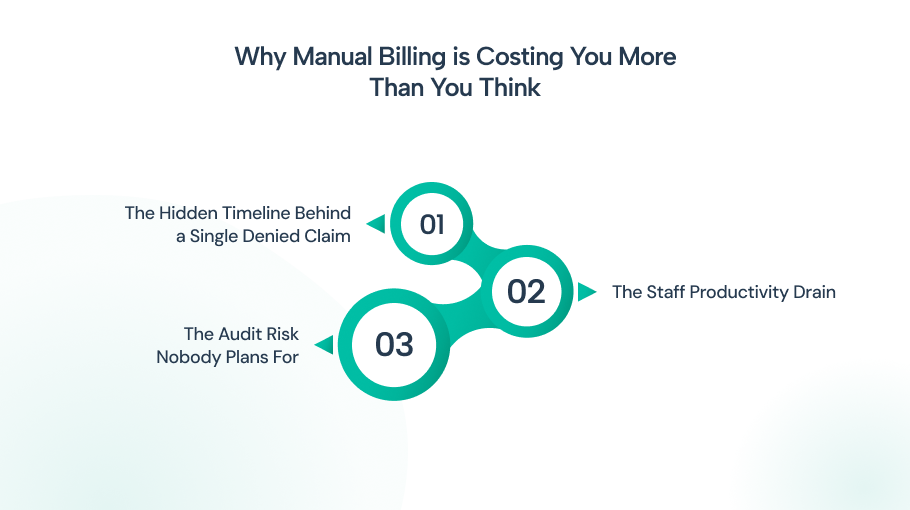
Why Manual Billing is Costing You More Than You Think
Most practices underestimate the true cost of manual billing. The obvious costs, denied claims, and resubmission labor are visible. The hidden costs are not.
The Hidden Timeline Behind a Single Denied Claim
Think about what happens when a claim is submitted with an eligibility error. It does not get denied immediately. It moves through the payer’s adjudication process, comes back weeks later, gets logged into a denial queue, is assigned to a staff member, researched, corrected, and resubmitted.
According to a Premier Inc. national survey of hospitals and health systems, each review cycle with insurers takes between 45 and 60 days, and most denials require an average of three rounds of review before resolution. Multiply that across hundreds of claims per month, and the compounding effect on cash flow becomes significant.
Multiply that across hundreds of claims per month, and the compounding effect on cash flow becomes significant.
The Staff Productivity Drain
Manual billing does not just cost money, but also costs capacity. Every hour a billing team member spends logging into individual payer portals, transcribing EOB data line by line, or chasing down a denial with no root cause information is an hour not spent on higher-value work.
That productivity drain is rarely measured directly, which is exactly why it persists. The work feels necessary because it is, but the volume of it is a structural problem, not a staffing one. No amount of hiring solves a workflow that was not designed for today’s billing complexity.
The Audit Risk Nobody Plans For
Manual processes also create audit exposure. When claim data is entered by hand, inconsistencies accumulate. Eligibility details get transcribed incorrectly, and diagnosis codes get applied without payer-specific validation.
These are not careless errors but are structural gaps in workflows that were not designed to handle today’s billing complexity.
What Automation Actually Does (And What It Does Not)
A common misconception is that healthcare payment automation means removing human judgment from the billing process. That is not what it means in practice.
Here is where automation creates measurable impact:
| Workflow Stage | Manual Approach | Automated Approach |
| Eligibility Verification | Staff call the payer or log into individual portals | Real-time EDI clearinghouse query at the time of scheduling |
| Claim Scrubbing | Manual review before submission | AI-powered rules engine catches clinical and payer-specific errors |
| Payment Posting | Manual EOB entry line by line | ERA auto-posting matches remittances to claims automatically |
| Denial Management | Staff reviews the denial queue manually | Organized denial worklists by payer, code, and aging with follow-up alerts |
| Patient Statements | Paper statements are printed and mailed manually | Electronic statements are transmitted to the mailing vendor automatically |
The Eligibility Problem Nobody Talks About Enough
Eligibility verification is one of the key processes where healthcare payment automation delivers the fastest and most measurable returns. Eligibility-related denials consistently rank among the top denial categories across specialties.
The reason is that insurance coverage changes frequently, and practices relying on manual verification simply cannot keep up.
Here is what that looks like in practice:
- Patients switch insurance plans mid-treatment without notifying the front desk
- Deductibles reset at the start of the year, changing what the patient owes overnight
- Policies lapse due to missed premium payments, often unknown to the patient at the time of the visit
- Group coverage terminates when an employer changes carriers, leaving employees temporarily uninsured
- Secondary insurance coordination is missed entirely when only primary coverage is verified
Any one of these scenarios can produce a denial that takes weeks to resolve. When manual verification is the norm, these situations are caught after the claim is already submitted, not before.
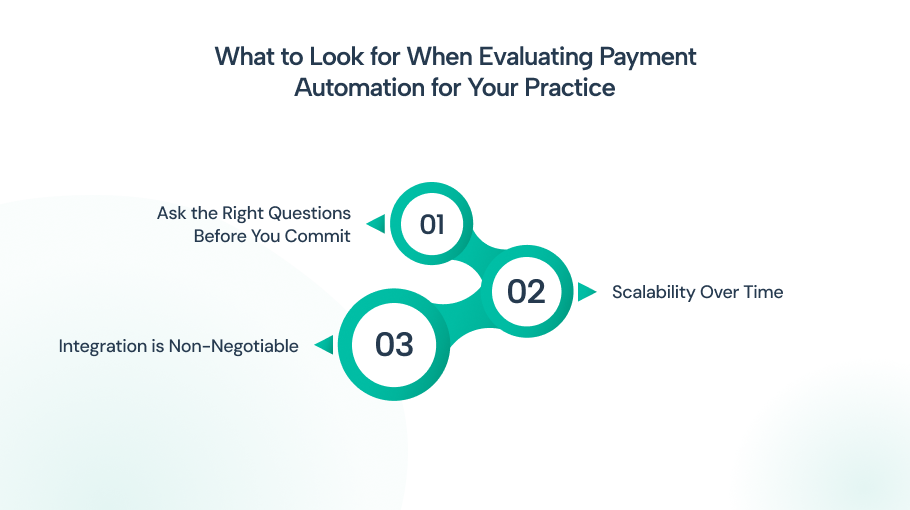
What to Look for When Evaluating Payment Automation for Your Practice
Not every healthcare payment automation solution is built the same way. A platform marketed as automated billing software might mean automated claim submission only, while still requiring manual posting, manual eligibility checks, and a separate portal for denial management.
Ask the Right Questions Before You Commit
Before committing to a platform, practices should ask specific questions about the full billing workflow.
Can the system verify eligibility in real time and run batch checks overnight? Does claim scrubbing go beyond basic format validation to catch payer-specific clinical coding errors? Is ERA posting fully automated, or does it require staff review for every remittance?
If the answer to any of these is unclear or incomplete, that is not a minor gap, but it is the difference between a billing tool and a revenue cycle platform.
Scalability Over Time
A solo provider may start with a platform that handles claims creation and basic reporting, but a growing practice needs multi-provider dashboards, advanced analytics, and integration with their existing EHR.
The best approach is a platform that scales with the practice from starter-level automation through full end-to-end RCM without requiring a system replacement at every growth stage.
Integration is Non-Negotiable
A billing platform that does not connect to the practice’s existing EHR creates data silos, duplicate entry, and exactly the kind of manual errors automation is supposed to prevent.
Ensure the platform supports HL7 v2, FHIR, and RESTful API connectivity, and confirm that your EHR is listed among the vendor’s supported integrations before making a decision.
Healthcare payment collection software is most effective when it connects the front end of the revenue cycle, scheduling, eligibility, and registration, directly to the back end, where claims are submitted, payments are posted, and denials are resolved. That connectivity is what separates a billing tool from a revenue cycle platform.
Before You Leave
The practices seeing the strongest financial outcomes from billing automation are not the ones that automated everything overnight.
They are the ones that started with the highest-impact workflows, including eligibility, claim scrubbing, ERA posting, built visibility into their denial patterns, and used that data to systematically reduce the revenue leakage that was hiding in their billing cycle.
Healthcare payment automation is not a technology decision but a financial strategy. The question is not whether to automate but which workflows to automate first, and whether the platform you choose gives you the analytics to know if it is working.
Platforms like CureAR help bring this layer of visibility by connecting automation with performance tracking, so teams can actually measure what is improving and what is not.
Frequently Asked Questions
Healthcare payment automation refers to the use of software to handle repetitive billing tasks such as eligibility verification, claim scrubbing, ERA posting, and patient statement generation without requiring manual staff input at each step.
Automation reduces denials primarily through two mechanisms: pre-submission claim scrubbing that catches coding and payer-specific errors before a claim is filed, and real-time eligibility verification that prevents coverage-related denials at the point of scheduling or service.
When combined with denial analytics, practices can also identify and eliminate systemic denial patterns over time.
Yes. Many healthcare payment automation platforms offer tiered pricing that makes automation accessible for solo providers and small practices, not just large health systems.
Healthcare payment automation covers the full billing workflow from eligibility through claim submission, payment posting, and denial management. Healthcare payment collection software typically refers specifically to the patient-facing payment tools, such as online payment portals, electronic statements, and balance collection workflows.
The most effective platforms include both as integrated components of a single system.
ROI timelines vary by practice size and starting denial rate, but practices that implement real-time eligibility verification and automated claim scrubbing typically see measurable improvement within the first billing cycle.
Denial rate reduction that comes from pattern-based analytics usually compounds over three to six months as systemic issues are identified and corrected upstream.