

Healthcare providers deliver care with the expectation that insurance reimbursement will follow. Yet for many practices, reimbursement is delayed or lost because claims are rejected during processing.
According to the Centers for Medicare & Medicaid Services, billing errors and documentation issues account for a significant portion of rejected healthcare claims every year. When these problems occur repeatedly, they can disrupt cash flow, increase administrative workload, and create unnecessary financial pressure on healthcare organizations.
Understanding the most common reasons behind claim rejections can play a crucial role in helping prevent them.
This blog will shed light on six of the most frequent causes of medical claim denials and highlight practical solutions to resolve them before they impact your practice’s revenue.
Why Claim Denials Matter More Than You Think
Even a small number of rejected claims can accumulate into significant financial losses over time. When a claim is denied, the practice must spend additional time investigating the issue, correcting information, and resubmitting the claim.
Healthcare research from the American Medical Association shows that the cost of reworking a single denied claim can range from $25 to more than $100, depending on the complexity of the case. When multiplied across hundreds or thousands of claims, these expenses quickly affect operational efficiency and profitability.
Common Causes of Medical Claim Denials and How to Fix Them
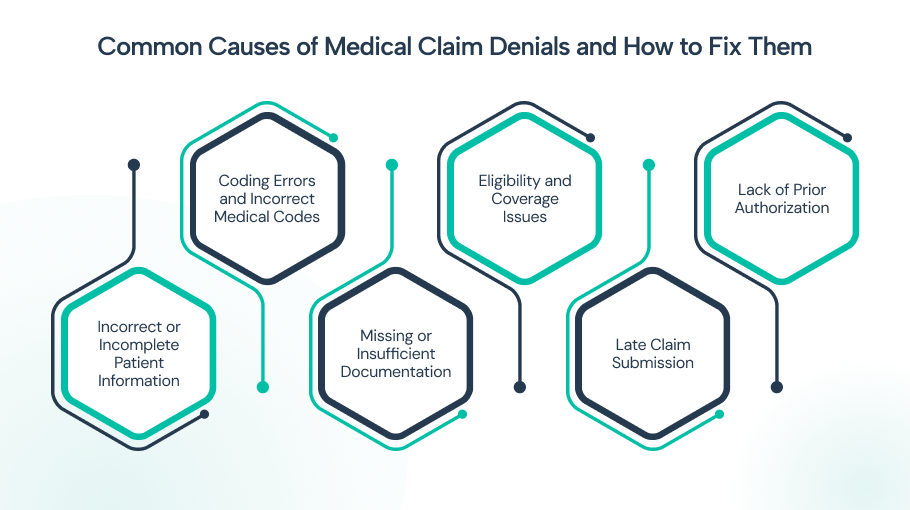
Medical claim denials often result from simple issues. Understanding these causes helps healthcare providers fix problems early and reduce claim rejections.
1. Incorrect or Incomplete Patient Information
Many denied claims originate from simple administrative errors during patient registration.
Missing Demographic or Insurance Details
A claim may be rejected when patient names are misspelled, policy numbers are incorrect, or insurance coverage information is outdated. Even small discrepancies between the patient record and the payer’s system can cause the claim to fail validation checks.
Solution: To prevent these issues, front-desk staff should verify patient demographics and insurance coverage during every visit. Implementing standardized intake procedures and digital verification tools can significantly reduce errors before claims are submitted.
2. Coding Errors and Incorrect Medical Codes
Coding inaccuracies remain one of the most frequent reasons healthcare claims fail during payer review.
Incorrect CPT, ICD-10, or Modifier Usage
Medical coders must ensure that diagnostic and procedure codes accurately reflect the services provided. When codes do not align with the documentation or when modifiers are missing, insurers may reject the claim.
Solution: Research published by the National Institutes of Health highlights that coding inaccuracies are among the leading contributors to reimbursement delays across healthcare systems. Proper coder training, periodic audits, and updated coding references help reduce the likelihood of these mistakes.
3. Missing or Insufficient Documentation
Insurance providers require clear clinical documentation to justify medical services.
Lack of Supporting Medical Records
If the submitted claim does not include adequate documentation to support medical necessity, insurers may reject it during review. This commonly occurs when physician notes are incomplete or when key clinical details are absent.
Solution: Healthcare organizations should establish documentation standards that ensure providers capture essential clinical information during patient encounters. Clear documentation not only supports reimbursement but also strengthens overall patient care records.
4. Eligibility and Coverage Issues
Claims may also fail when services are billed for patients who are not eligible under their insurance plan at the time of service.
Coverage Not Active or Benefits Exhausted
If the patient’s policy has expired or if certain services are not covered under the plan, the claim will likely be rejected by the payer.
Solution: To prevent these issues, eligibility verification should occur before every appointment. Automated eligibility checks integrated with cloud-based medical billing software can help confirm coverage in real time, reducing the risk of billing for non-covered services.
5. Late Claim Submission
Every insurance provider sets strict deadlines for claim submission.
Filing After the Payer’s Deadline
If a claim is submitted after the payer’s filing window has closed, it may be automatically rejected regardless of the accuracy of the claim itself. These deadlines vary widely depending on the insurance company and the type of coverage.
Solution: Establishing efficient billing workflows ensures claims are submitted promptly. Practices should monitor submission timelines closely and prioritize claims processing immediately after services are rendered.
6. Lack of Prior Authorization
Certain treatments and procedures require prior approval from insurance providers.
Services Performed Without Authorization
When healthcare providers perform services that require authorization but fail to obtain approval in advance, insurers may refuse payment for the claim.
Solution: Administrative teams should maintain clear authorization protocols and verify payer requirements before scheduling procedures. Integrating authorization tracking into the revenue cycle process helps ensure compliance with payer policies.
How Healthcare Practices Can Reduce Claim Denials
Reducing claim denials requires a proactive approach across the entire revenue cycle. Here are some tips for healthcare practices to better position themselves to prevent errors before claims are submitted.
1. Improve Billing and Coding Processes
Accurate billing and coding are the foundation of a healthy revenue cycle. Healthcare organizations should regularly review their billing practices to identify patterns such as incorrect codes, missing modifiers, or incomplete documentation. Periodic audits and ongoing staff training help ensure coding standards remain consistent and aligned with payer guidelines.
2. Improve Communication Between Clinical and Billing Teams
Clear coordination between clinical staff, coders, and billing teams plays a major role in reducing claim issues. When documentation clearly reflects the services provided, coders can assign accurate codes that meet payer requirements. Establishing shared documentation standards and encouraging regular collaboration between departments helps prevent errors that often lead to claim rejections.
3. Use Technology to Improve Claim Accuracy
Technology can significantly reduce the risk of human error in the billing process. Modern billing systems can verify patient eligibility, flag coding inconsistencies, and track authorization requirements before a claim is submitted. By integrating these tools into daily workflows, healthcare providers can improve claim accuracy and create a more efficient revenue cycle.
Wrapping Up
Medical claim denials are a persistent challenge for healthcare providers, but they are not inevitable. Most claim rejections occur because of preventable administrative errors, documentation gaps, or workflow inefficiencies.
By making a few changes and solidifying some foundational elements, healthcare organizations can significantly reduce the number of rejected claims they encounter. When practices proactively address these issues, they not only improve reimbursement outcomes but also create a more efficient and resilient revenue cycle.
Frequently Asked Questions
Medical claim denials occur when an insurance provider refuses to reimburse a healthcare service after reviewing the submitted claim. These rejections can happen due to coding errors, missing documentation, eligibility issues, or violations of payer policies.
Yes. Many rejected claims can be corrected and resubmitted after the underlying issue is resolved. However, the process often requires additional administrative work, which increases operational costs for healthcare providers.
Healthcare practices can reduce claim denials by verifying patient information, ensuring accurate medical coding, maintaining thorough documentation, and submitting claims within payer deadlines.
Effective denial management helps healthcare organizations protect revenue, improve billing accuracy, and reduce the administrative burden associated with correcting rejected claims.
A claim rejection occurs when a claim is not accepted for processing due to errors such as missing information or formatting issues. A claim denial happens after the insurance provider reviews the claim and determines that the service will not be reimbursed based on coverage rules or documentation.