

Did you know that anesthesia services are among the most complex to bill in the entire healthcare revenue cycle? Even minor errors in time units, modifiers, or documentation can quickly lead to claim denials, delayed reimbursements, or compliance issues.
For anesthesia practices, billing is not only a burdensome administrative task, but it also directly affects revenue, cash flow, and long-term stability.
This is why many practices are moving away from spreadsheets, manual entry, and generic systems and invest in anesthesia medical billing software that better suits their workflows.
Why Anesthesia Billing is Complex
Anesthesia billing is fundamentally different from standard medical billing. Payments are calculated using base units, time units, and multiple modifiers, all of which must be accurately documented and coded. On top of that, payer rules change often and vary by insurance type.
Common challenges anesthesia practices face include:
- Precise calculation of anesthesia time
- Correct use of physical status and concurrency modifiers
- Coordination between anesthesiologists, CRNAs, and facilities
- High denial rates due to documentation gaps
- Increased audit risk
Trying to manage these challenges without specialized software increases both financial and compliance risks. This is where medical billing software for anesthesia billing comes into play.
What is Anesthesia Medical Billing Software?
Medical billing software for anesthesia practice is a specialized solution that helps practices manage the unique and highly detailed billing requirements of anesthesia services. Unlike general medical billing systems, it is built specifically to support the workflows, calculations, and compliance rules that anesthesia practices deal with every day.
This type of software connects clinical documentation directly with the billing process. As a result, every service provided is accurately captured, coded correctly, and submitted on time.
The typical capabilities of a standard anesthesia billing software include:
- Accurate time-based billing
- Modifier validation
- Payer-specific rules
- Claim scrubbing
- Real-time reporting
By automating these critical functions, the software minimizes manual effort and lowers the risk of billing mistakes. Moreover, it helps practices stay compliant with changing regulations while improving operational efficiency.
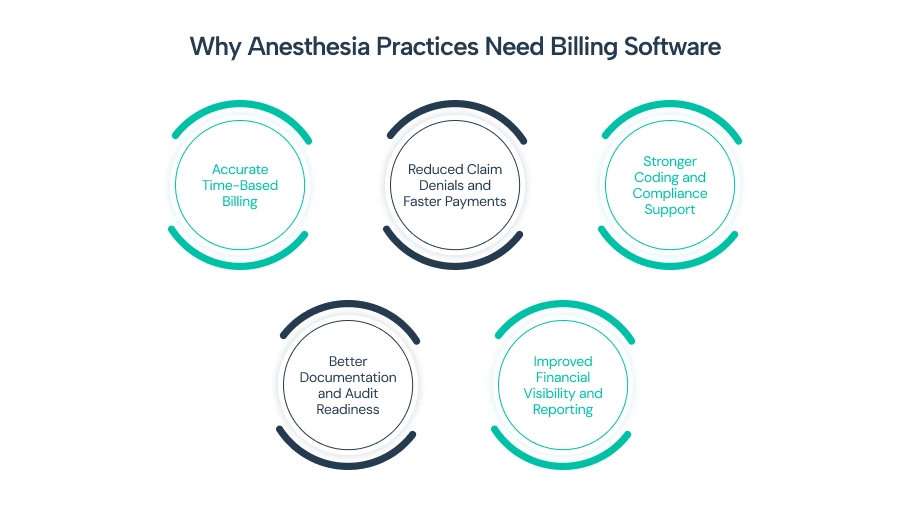
Why Anesthesia Practices Need Billing Software
Anesthesia practices deal with time-based billing rules that leave little room for error. Billing software helps streamline these processes. Here’s how:
Accurate Time-Based Billing
Anesthesia reimbursement depends heavily on correct time reporting. Even a few missing or incorrect minutes can impact payment amounts. Billing software automatically calculates time units using documented start and stop times, reducing human error.
The Centers for Medicare & Medicaid Services (CMS) clearly outlines that anesthesia time must be reported precisely for correct reimbursement under Medicare guidelines, reinforcing the importance of automation.
Reduced Claim Denials and Faster Payments
Manual billing often leads to missing modifiers, incorrect codes, or incomplete documentation. Anesthesia medical billing software includes built-in claim scrubbing tools that catch errors before claims are submitted.
This results in:
- Higher clean-claim rates
- Faster reimbursements
- Less time spent on appeals and rework
Over time, this significantly improves cash flow and revenue predictability.
Stronger Coding and Compliance Support
Coding errors are one of the leading causes of anesthesia claim denials. Specialized software stays updated with current CPT, ICD-10, and payer-specific rules, helping practices remain compliant.
Many systems also integrate anesthesia medical billing and coding software features that guide coders toward accurate code selection and modifier use. This reduces compliance risks and supports long-term operational health.
The American Society of Anesthesiologists (ASA) emphasizes the importance of correct coding and documentation to avoid audits and payment delays.
Better Documentation and Audit Readiness
Audits are a reality for anesthesia practices due to how complicated billing rules can be. Billing software keeps clinical notes, time logs, and billing data centralized and easy to retrieve.
This makes it easier to:
- Respond to payer audits
- Support medical necessity
- Reduce compliance exposure
Proper documentation not only protects revenue but also safeguards the practice during payer reviews.
Improved Financial Visibility and Reporting
Modern billing platforms provide dashboards and analytics that show exactly how a practice is performing. Instead of guessing where revenue is being lost, practices can identify issues early.
You can track:
- Denial patterns
- Payer reimbursement trends
- Provider productivity
- Days in accounts receivable
Research published on PubMed Central, hosted by the National Institutes of Health, explains that effective revenue cycle management systems improve financial stability, reduce billing errors, and streamline healthcare operations.
How Anesthesia Medical Billing Software Supports Practice Growth and Profitability
As anesthesia practices expand, billing operations become tougher to handle. Higher case volumes, multiple payers, and growing provider teams increase the risk of errors when relying on manual processes. Adding billing staff raises costs and still does not fully eliminate mistakes.
Reliable anesthesia medical billing software scales with the practice. It allows higher claim volumes to be processed accurately without increasing administrative workload.
Within this broader benefit, the software delivers value in several key ways:
- Supports Growth Without Adding Administrative Burden
As case volume increases, manual billing quickly becomes inefficient. Billing software handles higher workloads with consistent accuracy, reducing the need to hire additional staff while maintaining clean claims and steady cash flow.
- Improves Coordination Across Care Teams
Anesthesia services often involve multiple providers working at the same time. Billing software manages concurrency rules and makes sure each provider’s role is properly documented and billed. This is especially critical for hospital-based and large group practices.
- Delivers Long-Term Cost Savings
Although there is an initial investment, billing software generates measurable savings over time. Fewer denials, faster reimbursements, lower audit risk, and reduced administrative overhead all contribute to stronger financial performance.
Final Thoughts
Anesthesia billing involves strict rules and precise requirements that outdated tools and manual workflows cannot handle. With increasing payer scrutiny and evolving compliance requirements, practices need smarter systems to stay competitive.
Anesthesia medical billing software improves accuracy, speeds up reimbursements, strengthens compliance, and provides valuable financial insights. For anesthesia practices looking to protect revenue and simplify operations, adopting the right billing software is no longer optional. It is essential.
Frequently Asked Questions
Unlike standard medical billing, which often uses flat fees, anesthesia reimbursement is a dynamic calculation involving base units, precise time increments, and physical status modifiers. Specialized software automates these unique formulas, ensuring every minute of care is accounted for and billed at the correct payer-specific rate.
Yes, specialized platforms use built-in "claim scrubbing" technology to catch common anesthesia errors, such as missing modifiers or concurrency conflicts, before submission. By validating data against current CPT and ICD-10 rules, the software ensures higher clean-claim rates and faster payment cycles.
The software automatically tracks when an anesthesiologist is supervising multiple CRNAs or residents across different cases simultaneously. It enforces CMS concurrency limits in real-time, preventing compliance red flags and ensuring that each claim reflects the correct medical direction or supervision modifiers.
Most modern anesthesia billing solutions are designed to sync seamlessly with your Electronic Health Records (EHR) to pull clinical data directly into the billing workflow. This integration eliminates manual data entry, reduces the risk of human error, and ensures that clinical documentation perfectly supports every billed charge.
The platform centralizes all clinical notes, time logs, and modifier justifications into a digital paper trail that is easily accessible during a payer review. This organized, transparent documentation proves medical necessity and accuracy, significantly lowering your practice's financial and legal exposure during an audit.