Most billing teams already know the feeling of watching a clean claim get denied over a coding mismatch nobody caught in time. That single moment, repeated across hundreds of claims a month, is what drains a practice’s cash flow and burns out the staff trying to fix it.
A growing number of practices are now turning to artificial intelligence for medical billing to catch these problems before they ever reach a payer. This isn’t a future concept anymore; it’s already changing how claims move through the revenue cycle at practices of every size.
The results show up in fewer denials, faster payments, and staff who finally have time for work that actually needs a human.
Quick summary:
Artificial intelligence for medical billing helps practices automate repetitive tasks, catch coding errors before submission, speed up claims processing, cut denial rates, and collect revenue faster. Below are five specific ways it does that, along with a side-by-side look at manual billing versus AI-assisted billing, and answers to the questions providers ask most often.
Key Takeaways
- Manual data entry and repetitive billing tasks can be automated, freeing staff for patient-facing work
- AI-driven error checks catch coding and claim mistakes before a claim ever reaches the payer
- Claims move through the revenue cycle faster when AI flags issues in real time
- Denial rates drop when AI predicts and prevents the most common denial triggers
- Revenue collection improves because clean claims get paid faster and with fewer resubmissions
Why Practices Are Rethinking Their Billing Process
Claim denials have been a growing headache for practices of every size, and the numbers back that up. A March 2024 MGMA Stat poll found that 60% of medical group leaders reported an increase in their practices’ claim denial rates compared to the same period the prior year. It’s rarely one big mistake behind that number.
It’s usually a string of small ones, an outdated code, a missed eligibility check, a prior authorization that expired between visits, that add up to lost revenue and slower payments.
This is exactly the gap that medical billing software with built-in intelligence is designed to close. Instead of relying on staff to catch every possible error by hand, the software checks claims against current payer rules, coding updates, and eligibility data before anything gets submitted.
If you’re comparing options for your own practice, a related breakdown of how modern billing platforms fit into daily operations is worth a look in the guide on why medical billing software is a game-changer for clinics.
Five Ways Artificial Intelligence for Medical Billing Saves Time and Money
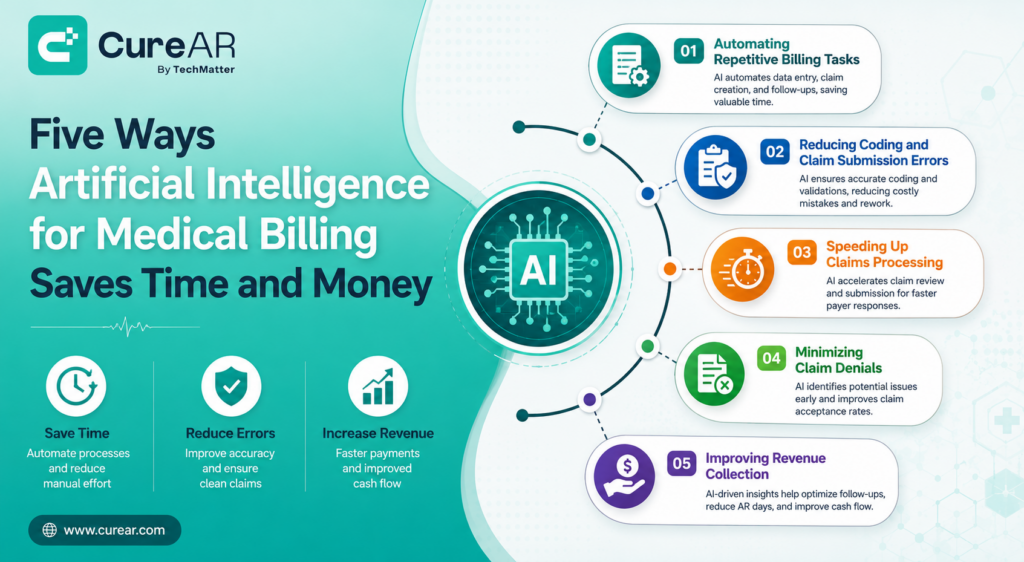
The benefits of automation in billing aren’t abstract. They show up in specific, measurable parts of the revenue cycle, and each one compounds the effect of the others.
1. Automating Repetitive Billing Tasks
Data entry, eligibility checks, and charge posting take up a large share of a billing team’s day, and none of it requires judgment calls. AI-powered systems handle these repetitive steps automatically, pulling patient and insurance details, verifying coverage, and posting charges without someone re-typing the same information across multiple screens.
That shift matters more than it sounds, because every hour a biller isn’t retyping data is an hour they can spend on a denied claim or a patient payment plan instead.
2. Reducing Coding and Claim Submission Errors
Coding errors are one of the most common reasons claims bounce back, and they’re often avoidable with the right checks in place.
AI tools compare each claim against current coding guidelines and payer-specific rules before submission, flagging mismatches between diagnosis and procedure codes, missing modifiers, or documentation gaps. Catching these issues before a claim goes out costs far less than fixing them after a denial comes back.
3. Speeding Up Claims Processing
Once a claim clears its error checks, AI systems can route it for submission almost immediately instead of waiting in a batch queue. This matters because every day a clean claim sits unsubmitted is a day added to your payment cycle.
Practices using automated claims processing typically see fewer bottlenecks between the point of service and the point of payment, which shows up directly in cash flow.
4. Minimizing Claim Denials
Denial prevention is where AI tends to make the biggest financial difference, because it works before a claim is ever sent rather than after it comes back. Predictive models look at historical denial patterns for a given payer or code, and flag claims likely to be rejected, giving staff a chance to fix the issue in advance.
Fewer denials also mean fewer staff hours spent on appeals, which is time that goes back into other parts of the revenue cycle.
5. Improving Revenue Collection
Fewer denials and faster submissions add up to a simple result: collected revenue stays closer to what was actually billed. When claims go out clean the first time, practices stop losing money to write-offs, timely filing limits, and the slow drip of partial payments that come from repeated resubmissions.
Over time, that gap between billed revenue and collected revenue is one of the clearest ways to measure whether a billing process is actually working, and it’s the number most practice owners care about most.
Manual Billing vs AI-Powered Billing at a Glance
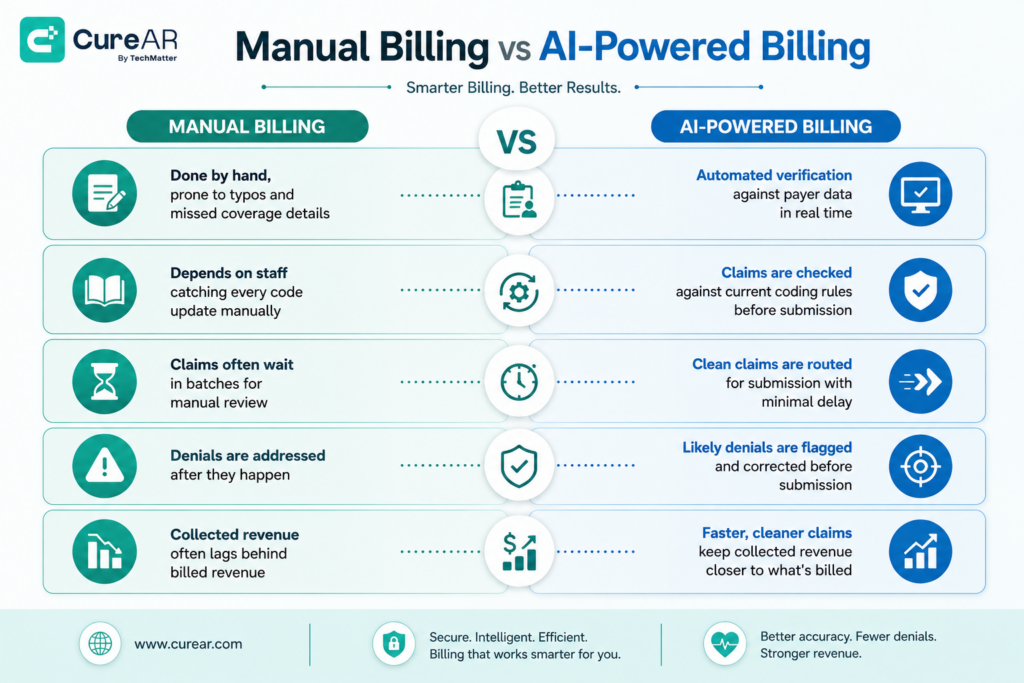
| Task | Manual billing process | AI-powered billing process |
| Data entry and eligibility checks | Done by hand, prone to typos and missed coverage details | Automated verification against payer data in real time |
| Coding accuracy | Depends on staff catching every code update manually | Claims are checked against current coding rules before submission |
| Claims processing speed | Claims often wait in batches for manual review | Clean claims are routed for submission with minimal delay |
| Denial management | Denials are addressed after they happen | Likely denials are flagged and corrected before submission |
| Revenue collection | Collected revenue often lags behind billed revenue | Faster, cleaner claims keep collected revenue closer to what’s billed |
What This Means for Your Staff and Your Patients
Reducing the administrative burden on billing staff has a ripple effect beyond the finance office. When your team isn’t buried in repetitive data entry and denial appeals, they have more time for patient questions about bills, payment plans, and coverage, which is a side benefit most conversations about billing automation tend to skip over.
Patients notice the difference too, since clearer bills and fewer errors mean fewer confusing statements and fewer back-and-forth calls to sort out a mistake. It’s worth being honest that AI doesn’t eliminate the need for skilled billing staff; it just shifts their time from repetitive checks to the exceptions that genuinely need a person’s judgment.
Choosing the Right AI Billing Partner for Your Practice
Not every platform that claims to use AI actually applies it where it matters most, which is before a claim goes out the door. Look for revenue cycle management tools that show their error-checking logic, update coding rules automatically, and give staff visibility into why a claim was flagged.
CureAR builds these checks directly into its claims workflow, so practices can catch problems at the point of submission instead of chasing them down weeks later.
Conclusion
Billing pressure isn’t going away, and practices that keep relying on fully manual processes will keep absorbing the cost of preventable errors and denials. Artificial intelligence for medical billing gives practices a practical way to catch problems earlier, move claims faster, and get staff back to work that actually needs their attention.
If you’re curious what a smarter billing workflow could look like for your own practice, it’s worth taking a closer look at how a platform like CureAR handles these checks before a claim ever reaches a payer.
Frequently Asked Questions
No, it doesn't replace them. It takes over repetitive tasks like data entry and initial error checks, which frees billers to focus on complex claims, appeals, and patient communication that still need human judgment.
AI systems compare claims against payer rules and historical denial patterns before submission, flagging likely problems in advance. This lets staff fix issues before a claim is sent instead of after a denial arrives.
Costs vary by vendor and by the size of your claims volume. Many practices find that the reduction in denied claims and staff overtime offsets the software cost within the first several months.
Most practices notice fewer coding errors and faster claim turnaround within the first billing cycle or two. Full financial impact, including denial rate improvements, usually becomes clear over two to three months.
Most modern platforms are built to integrate with common EHR and practice management systems rather than replace them. It's worth confirming integration details with any vendor before you commit, since compatibility varies.