
“This blog explores how workflow automation is transforming healthcare claims processing, from eligibility verification and claim scrubbing to denial management and compliance monitoring, and what that means for revenue cycle performance and financial stability.”
Healthcare billing has always been complex. But as payer rules tighten, claim volumes grow, and administrative costs rise, manual claims workflows are no longer sustainable for most practices. According to the American Medical Association, the administrative cost of reworking a single denied claim can range from $25 to over $100, depending on complexity.
Claims automation software like CureAR is changing that by replacing disconnected, reactive processes with connected, intelligent workflows that catch problems early and keep the revenue cycle moving.
The Problem with Manual Claims Workflows
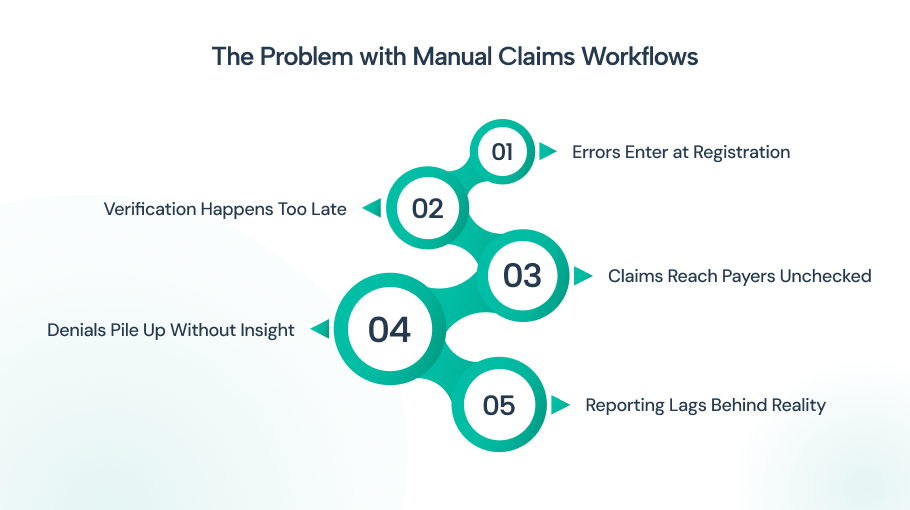
Manual billing is not just slow. It is structurally prone to failure at every stage of the claims process.
Errors Enter at Registration
When staff enter patient data by hand, small mistakes like incorrect insurance IDs, misspelled names, or outdated policy numbers pass through undetected. These errors do not surface until a claim is rejected weeks later.
Verification Happens Too Late
Without automated eligibility checks, coverage mismatches are often discovered after a claim is submitted rather than before the appointment. By that point, the error has already cost the practice a reimbursement cycle.
Claims Reach Payers Unchecked
Manual workflows rarely include pre-submission scrubbing. Coding errors, missing modifiers, and medical necessity gaps reach the payer undetected, resulting in denials that require time-consuming rework.
Denials Pile Up Without Insight
When denials are tracked manually, billing teams see that claims were rejected but rarely understand why patterns are recurring. The same issues get corrected claim by claim rather than resolved at the process level.
Reporting Lags Behind Reality
Spreadsheets and disconnected systems mean financial reports are always backward-looking. By the time a trend in denial rates or accounts receivable aging is identified, revenue has already been affected.
Why Traditional Processes Break Down
Manual workflows share a common structural weakness. Each stage of the claims process operates in isolation. Scheduling does not communicate with billing. Billing does not communicate with coding in real time. The result is a billing cycle that reacts to problems rather than preventing them.
Key Areas Where Automation Improves Claims Processing
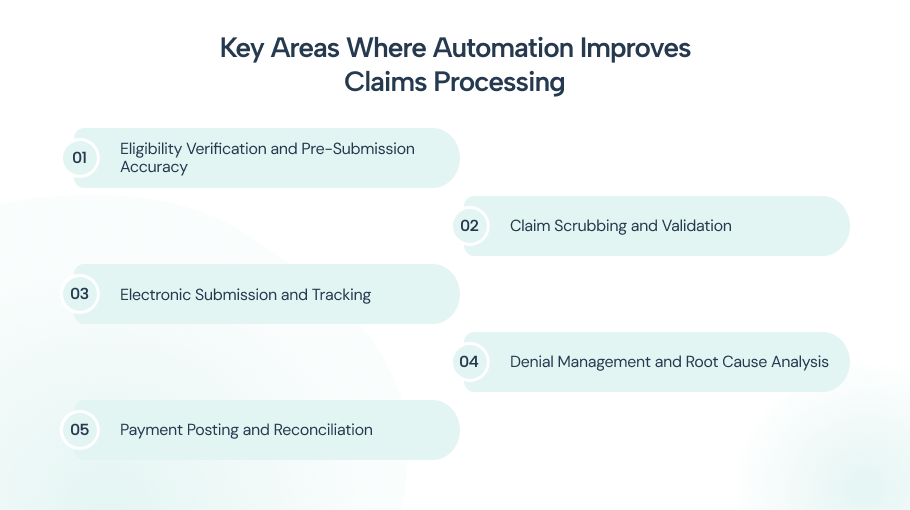
The following sections outline the key areas where automation strengthens claims processing and supports consistent revenue cycle performance.
Eligibility Verification and Pre-Submission Accuracy
Real-time eligibility checks reduce the risk of billing inactive or ineligible patients. Automated systems cross-verify coverage before services are finalized. This reduces front-end errors that often lead to downstream denials.
Claim Scrubbing and Validation
Automated claims scrubbing tools review diagnosis codes, modifiers, and payer rules before submission. This step significantly reduces preventable denials.
According to the American Hospital Association, administrative complexity continues to increase operational burden across hospitals. Automation helps reduce that burden by standardizing validation processes.
Electronic Submission and Tracking
Automated platforms transmit claims electronically and monitor payer responses in real time. Status updates are logged automatically. This eliminates manual status checks and reduces delays.
Denial Management and Root Cause Analysis
Automation tracks denial patterns and categorizes them by payer or reason code. Instead of reactive corrections, teams can address systemic issues. Analytics dashboards highlight trends. Leaders gain insight into recurring coding gaps or authorization issues.
Payment Posting and Reconciliation
Automated remittance posting reduces manual reconciliation errors. Electronic remittance advice files are matched with claims and posted automatically. This speeds up revenue recognition and reduces discrepancies.
The Operational Impact of Automation
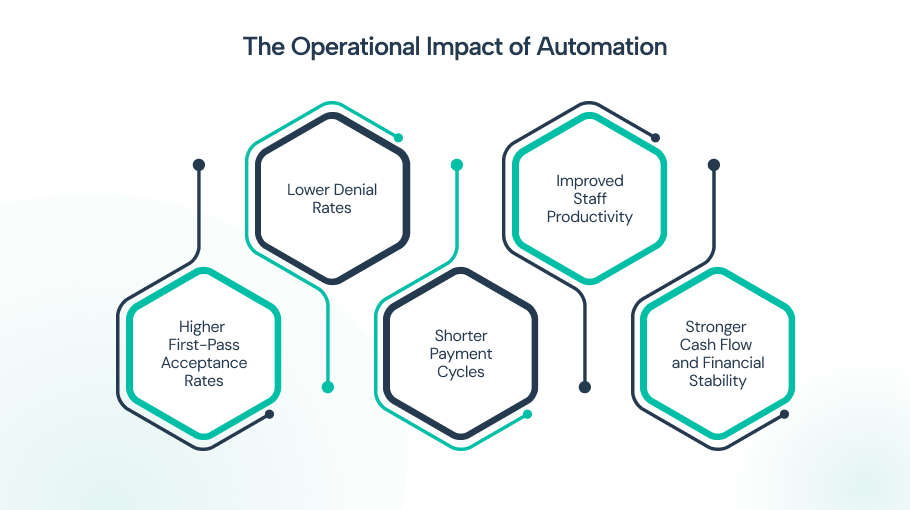
The shift to digital claims management tools produces measurable improvements across the revenue cycle. These are not incremental gains. They fundamentally change how billing teams operate.
Higher First-Pass Acceptance Rates
Pre-submission scrubbing catches coding errors, missing modifiers, and payer rule violations before claims reach insurers. This directly improves the percentage of claims accepted on the first submission, reducing the volume of rejections that require rework and resubmission.
Lower Denial Rates
When eligibility is verified before appointments and claims are scrubbed before submission, the most common causes of denial are resolved upstream.
Billing teams spend less time recovering denied claims and more time managing a cleaner, more predictable revenue cycle.
Shorter Payment Cycles
Automated ERA posting matches remittance data to open claims in real time, eliminating the delays associated with manual reconciliation. Payments are posted faster, outstanding balances are updated immediately, and billing teams gain a clearer picture of where collections stand at any given moment.
Improved Staff Productivity
When repetitive tasks like data entry, eligibility checks, and payment posting are handled automatically, billing staff can focus on work that requires judgment and expertise.
Complex denials, payer negotiations, and documentation reviews get the attention they deserve rather than being deprioritized in favor of manual processing.
Stronger Cash Flow and Financial Stability
Faster reimbursements, fewer denials, and more accurate payment posting combine to produce more predictable revenue.
Practices that operate with consistent cash flow are better positioned to manage operational expenses, invest in growth, and maintain financial stability over the long term.
Choosing the Right Automation Platform
Not all claims workflow automation tools are built with the same depth. When evaluating platforms, healthcare organizations should look for systems that cover the full revenue cycle rather than automating isolated steps.
A platform integrated with reliable Medical Billing Software will connect eligibility verification, claim scrubbing, submission, denial management, payment posting, and reporting in a single workflow.
This eliminates the handoff errors that occur when separate systems are used for each stage.
Full Revenue Cycle Coverage
The most effective platforms automate every stage of the claims lifecycle rather than isolated steps.
When eligibility verification, claim scrubbing, submission, denial tracking, and payment posting all operate within the same system, handoff errors are eliminated, and data flows consistently from one stage to the next.
EHR and Practice Management Integration
Clinical documentation should flow directly into billing workflows without manual data entry between systems.
Platforms that integrate with existing EHR and practice management systems reduce duplication, minimize transcription errors, and ensure that what is documented clinically is reflected accurately in every claim submitted.
Clearinghouse Connectivity
Strong clearinghouse integration allows claims to be submitted electronically across multiple payers through a single portal.
This removes the need for separate submission pipelines for each insurer and reduces the formatting errors that commonly occur during manual claim preparation.
Scalability for Growing Operations
As claim volumes grow and practices expand to multiple locations, the platform should scale without requiring system migrations or workflow overhauls.
Organizations managing multiple providers or NPIs need a system that handles increased complexity without adding administrative overhead.
Built-In Compliance Monitoring
Payer rules and coding standards change regularly. A reliable platform maintains up-to-date compliance rules within its scrubbing engine and flags claims that fall outside current requirements before submission.
This reduces audit exposure and ensures billing accuracy as regulations evolve.
Conclusion
Healthcare claims processing is no longer sustainable through manual workflows alone. Increasing payer scrutiny, regulatory oversight, and documentation demands require structured digital solutions.
Claims automation software offers a practical and scalable approach to reducing errors, improving compliance, and accelerating reimbursements.
Organizations that invest in automation gain operational clarity and financial stability. As reimbursement environments evolve, intelligent workflow automation will continue to define efficient revenue cycle management.
If your organization is evaluating ways to strengthen claims accuracy and operational efficiency, exploring structured automation solutions may be the next logical step toward long-term performance improvement.
Frequently Asked Questions
It is a digital system that automates eligibility checks, claim validation, submission, tracking, denial analysis, and payment posting within healthcare organizations.
No. Automation supports staff by reducing repetitive tasks. It allows teams to focus on complex cases and strategic oversight.
Automated validation rules catch coding errors, missing documentation, and payer-specific mismatches before claims are submitted.
Yes. Modern systems are built to align with federal and payer guidelines. They maintain audit trails and structured documentation controls.
It increases clean claim rates, accelerates reimbursements, reduces rework, and enhances financial predictability.