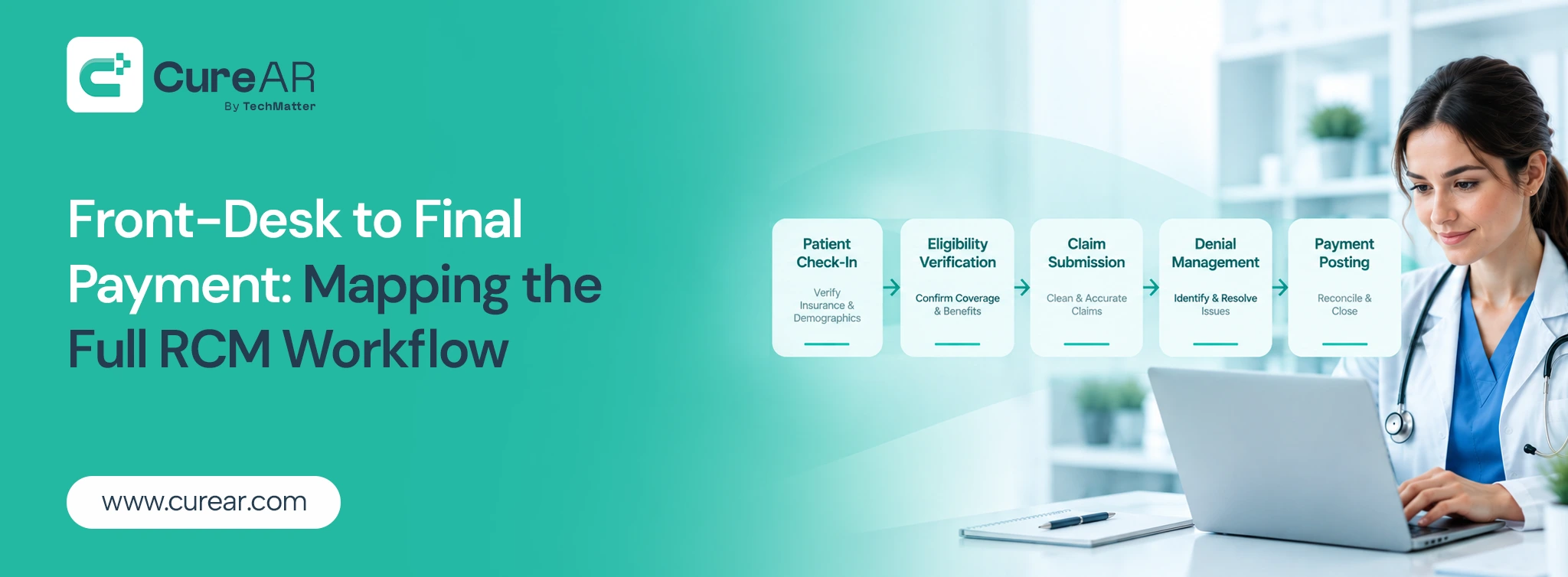
A revenue cycle management workflow is the sequence of administrative and clinical steps a healthcare practice follows from the moment a patient books an appointment to the moment the claim is fully paid. It spans front-desk registration, insurance eligibility checks, coding, claim submission, payer adjudication, and accounts receivable follow-up. Each stage feeds the next, so an error at intake can surface as a denial weeks later. Understanding the full sequence not just the billing department’s piece of it is what separates practices with predictable cash flow from practices chasing money every month.
Where the Workflow Actually Breaks
Most billing teams inherit a broken sequence rather than build one. A patient calls to schedule a visit. The front-desk staffer, juggling three other calls, types the insurance ID slightly wrong. Nobody catches it because eligibility verification happens, if at all, the morning of the appointment sometimes after the patient has already been seen. The claim goes out with a subtle mismatch between what the payer has on file and what the practice submitted. Three weeks later, a denial lands in the billing queue with a code nobody has time to decode properly.
This is not a story about careless staff. It’s a story about a workflow with no single owner. Front-desk teams are measured on how many patients they get through the door, not on data accuracy. Billing teams are measured on collections, not on the intake process that determines whether a claim is clean in the first place. The two teams rarely see the same dashboard, so nobody notices the pattern until denials pile up and someone finally asks: where did this actually go wrong?
The same disconnect shows up in a slightly different form with network status. A practice adds a new provider who hasn’t finished payer credentialing yet, but scheduling doesn’t flag that. The patient is booked as if the visit will be in-network, treated accordingly, and the claim goes out under standard timelines. When the payer treats the provider as out-of-network instead, the reimbursement cycle stretches from roughly 30 days to 90 or more, and the patient’s cost-share estimate already communicated to them at check-in turns out to be wrong. Nobody lied to the patient. The information simply didn’t travel from credentialing to scheduling to the front desk in time.
The Three Phases of an RCM Process
The revenue cycle has three broad phases, and most practices only pay close attention to the middle one.
Front-end: intake, eligibility, and authorization. This is where the patient’s insurance information, demographics, and reason for visit get captured. It includes verifying active coverage, checking whether the planned service requires prior authorization, and confirming the patient’s cost-share. Providers typically organize this phase as pre-registration through prior authorization, and it accounts for a large share of preventable errors, because it happens fastest and under the least scrutiny. A rushed five-minute phone intake determines the accuracy of everything that follows for the next thirty to ninety days.
Prior authorization deserves particular attention here, because it’s the front-end step most likely to be skipped under time pressure. Certain procedures, imaging studies, and specialty referrals require the payer’s advance sign-off before the service is considered reimbursable at all. Skipping that check doesn’t just risk a slower payment it risks the practice performing a service it will never be paid for. The CMS Interoperability and Prior Authorization Final Rule, which took operational effect at the start of 2026, is pushing payers toward faster electronic prior-auth responses, but the practice still has to know a given service requires authorization before the appointment happens, not after.
Mid-cycle: documentation, coding, and claim creation. The provider documents the encounter. A coder translates that documentation into ICD-10 diagnosis codes and CPT procedure codes. Those codes populate the CMS-1500 claim form, which becomes the actual financial ask sent to the payer. Every code has to match the documentation, the payer’s coverage rules, and any prior authorization already on file. A mismatch anywhere in that chain is a potential denial. This is also the phase where specificity matters most: a diagnosis code that’s technically correct but not specific enough for the payer’s medical necessity rules can trigger a denial just as easily as an outright coding error.
Back-end: submission, adjudication, posting, and follow-up. The claim goes to a clearinghouse, which scrubs it for formatting errors and routes it to the correct payer. The payer’s system reads the codes and returns one of three outcomes: payment (an Explanation of Remittance), a request for more information, or a denial. Payments get posted against the patient’s account, and anything still outstanding moves into accounts receivable, where someone has to track it until it’s resolved or written off. This is also where the clock genuinely matters: most payers set a hard window often 90 to 180 days depending on the contract for filing an appeal, and once that window closes, a denial that could have been reversed simply becomes lost revenue.
The workflow only functions as a system if information flows backward as well as forward if a denial pattern discovered in accounts receivable makes its way back to whoever handles intake, so the same mistake doesn’t repeat next month. Without that feedback loop, a practice can run the same avoidable error for years without anyone connecting the dots between a front-desk habit and a recurring denial code.
A Misconception Worth Correcting
A common belief is that better coders fix denial problems. Coders can only work with what they’re given. If the front desk captured the wrong policy number, or nobody verified eligibility before the visit, the most accurate coding in the world still produces a claim built on bad data. Historical single-specialty first-submission denial benchmarks sit around 8 percent, according to MGMA’s DataDive Practice Operations data, and much of that traces upstream of coding to registration accuracy, eligibility timing, and authorization gaps.
A second misconception: that denial management is where the revenue cycle management workflow “really” gets managed, so it deserves the most staffing attention. In practice, the highest-leverage work happens earlier. MGMA estimates that roughly half to nearly two-thirds of denials are never reworked at all not because staff don’t care, but because appeal deadlines pass while claims sit in a queue. Preventing a denial is cheaper and more reliable than chasing one after the fact.
A third misconception, and possibly the most persistent one: that a high denial rate is primarily a reflection of payer behavior that payers are simply getting stricter, so there’s not much a practice can do about it. Payer scrutiny has genuinely increased; industry reporting on initial denial rates shows a climb from roughly 10 percent in 2020 to nearly 12 percent in 2024. But a rising baseline doesn’t mean an individual practice’s denial rate is out of its own hands. The practices holding steady well below the industry average tend to be the ones with the tightest front-end data discipline, not the ones facing gentler payers.
It’s worth sitting with that distinction for a moment, because it changes where a practice puts its energy. If denials are treated as an external weather pattern, the natural response is to build a bigger appeals team and wait it out. If denials are treated as a signal about the practice’s own data quality, the response looks different: audit where the errors actually cluster, assign clear ownership for the specific handoff where they originate, and measure progress at that handoff rather than only at the aggregate denial rate. Both responses cost money and staff time. Only one of them tends to bend the underlying trend rather than just managing its symptoms.
What This Looks Like Across Different Practice Sizes
A solo practitioner’s front desk and billing function might be the same two or three people, which sounds like it should make continuity easier everyone already knows everything. In reality, small practices often skip formal handoff steps entirely because they assume shared context makes them unnecessary. A biller who also answers phones knows the patient personally, but that familiarity doesn’t substitute for a documented eligibility check, and busy days still produce the same shortcuts under time pressure that larger practices see.
A multi-provider group or billing company managing several practices faces the opposite risk: too many handoffs, across too many people, with no consistent format for passing information between them. One provider’s front desk might flag authorization requirements meticulously; another’s might not track them at all. Without a shared system, the workflow’s reliability becomes dependent on which individual happens to be working the front desk that day, rather than on the process itself. This is where a shared dashboard tends to matter most not because larger organizations need more technology for its own sake, but because they have more seams where the thread can snap, and less natural visibility into where that’s happening.
A Realistic Timeline for Fixing It
Fixing a fragmented revenue cycle workflow is not a weekend project, and no honest guide will tell you otherwise. Front-desk habits built over years don’t change because of a new checklist taped to a monitor. Realistically, most practices see the first measurable shift fewer eligibility-related denials within one to two billing cycles of tightening intake verification, simply because that’s how long it takes for the corrected claims to move through submission and adjudication.
Structural change, like getting front-desk and billing teams looking at the same denial data, tends to take longer: a full quarter is a reasonable expectation before the pattern becomes visible in aggregate numbers rather than anecdotes. There’s no guarantee a given practice hits that timeline payer mix, staff turnover, and specialty complexity all move the needle. What is fairly consistent is the order of operations: intake accuracy improves first, coding and submission quality follow, and accounts receivable aging improves last, because it’s downstream of everything else.
It’s also worth being honest about what doesn’t shrink quickly: existing accounts receivable. A cleaner front-end reduces how many new claims run into trouble, but it does nothing for claims already sitting in AR from before the change. Those still have to be worked through the old-fashioned way reviewed, appealed where possible, and written off where the filing window has closed. Practices sometimes get discouraged in month one or two because the AR total hasn’t moved, without realizing that number reflects the old process, not the new one. The AR curve typically bends only after the newer, cleaner claims start to outnumber the legacy backlog.
The Real Constraint: Visibility, Not Effort
The single constraint underneath most revenue cycle problems is visibility fragmentation not a lack of effort, but a lack of shared, real-time information across the stages of the workflow. Front-desk staff don’t see which claims are denying and why. Billing staff don’t see which appointments were booked with incomplete information. Practice leadership sees a monthly AR report but not the upstream cause of this month’s spike.
This is the idea behind what we call the Cycle Continuity Model: treating the revenue cycle not as a relay race with separate runners, but as one continuous data thread that has to stay intact from the first phone call to the final payment posting. Every handoff scheduling to intake, intake to coding, coding to submission, submission to AR is a place where the thread can snap. The model’s premise is simple: fix the handoffs, and the individual steps mostly take care of themselves.
Applied practically, this means a denial reason surfacing in accounts receivable shouldn’t dead-end in a spreadsheet the billing team keeps to themselves. It should be visible, in close to real time, to whoever owns the step upstream where the error actually originated even if that’s a scheduling coordinator who has never opened a denial report in their life. The model doesn’t require every employee to become a billing expert. It requires the specific piece of information relevant to their step of the workflow to actually reach them.
CureAR’s AI-driven Revenue Cycle Management Software is built around this idea. Rather than functioning as another isolated billing tool, it connects the workflow so that AR aging, denial reasons, and claim-level intelligence sit on one dashboard instead of being scattered across separate logins. The goal isn’t to replace the judgment of front-desk or billing staff it’s to make sure the information they each need to do their part well is actually in front of them, instead of trapped in a different department’s system.
The Metrics Worth Watching at Each Handoff
Tracking the revenue cycle as a whole is useful for a monthly report, but it’s not specific enough to catch where a handoff is failing in real time. It helps to attach a narrower metric to each phase instead of relying on one aggregate number.
At the front-end: eligibility verification completion rate before the appointment, not on the day of it, and the percentage of scheduled visits with prior authorization confirmed in advance where required.
At mid-cycle: clean claim rate the share of claims that go out the door without needing correction and average time from encounter documentation to claim submission.
At the back-end: first-pass resolution rate, days in accounts receivable, and the percentage of denials worked within the payer’s appeal window rather than after it closes.
None of these numbers replace the overall denial rate as a headline metric. But when the headline number moves in the wrong direction, having these narrower figures already tracked means a practice can look at which specific handoff shifted, instead of starting an investigation from scratch.
See Where Your Own Workflow Loses the Thread
If you’re not sure exactly where your own revenue cycle workflow is losing the thread whether it’s at intake, at coding, or somewhere in the accounts receivable queue that’s worth a second look before you invest in new tools or headcount.
What Doesn’t Actually Fix This
Hiring more billing staff without fixing intake. More people working a broken process just means more people manually catching the same category of error, faster. It doesn’t reduce how often the error occurs.
Generic staff training with no data feedback loop. A training session on “denial prevention” without specific, practice-level denial data attached to it teaches general principles the team likely already knows in the abstract. It doesn’t tell them which payer, which code, or which front-desk habit is actually causing this practice’s denials.
Switching EHR or practice management systems expecting the workflow to fix itself. A new system can improve documentation speed or interface design, but if front-desk and billing teams still aren’t seeing shared claim and denial data, the same visibility gap persists in a newer interface.
hasing denials harder instead of preventing them. Investing entirely in appeals and rebuttals treats the symptom. Across large claim volumes, roughly half of all human touches on the revenue cycle are estimated to be wasted effort spent reacting to problems that better upstream data could have prevented in the first place.
Outsourcing the whole revenue cycle as a first move. Handing the entire process to a third party can work, but it doesn’t automatically solve a visibility problem it just relocates it to a vendor’s system, which the practice may see even less of than its own. Outsourcing is a reasonable option when internal expertise or staffing is genuinely the constraint; it’s a weaker fix when the real issue is that front-desk and billing teams simply aren’t looking at the same data yet.
Frequently Asked Questions
Front-end (registration, eligibility, prior authorization), mid-cycle (documentation, coding, claim creation), and back-end (submission, adjudication, payment posting, AR follow-up).
Most trace back to the front-end — inaccurate registration data, skipped or late eligibility checks, and missed prior authorizations — even though they often surface later as coding or claim-level denials.
Historical single-specialty benchmarks sit around 8%, though many organizations now report rates above 10%, so tracking your own trend matters more than hitting one universal number.
Eligibility-related fixes often show up within one to two billing cycles; structural, cross-team improvements typically take closer to a full quarter to become visible in the data.
No. Coding accuracy can't compensate for inaccurate registration data or missed authorizations captured earlier in the workflow.
A clearinghouse scrubs and routes claims to payers. A revenue cycle dashboard, like CureAR, sits on top of that infrastructure to give billing teams unified visibility into claim status, denials, and AR — without replacing the clearinghouse itself.
No — many practices improve outcomes significantly just by closing the visibility gap between front-desk and billing teams, without outsourcing any function.
Skipping a required prior authorization doesn't just slow a claim down — it can mean the service is never reimbursed at all, regardless of how accurate the coding is afterward.
Existing AR reflects claims that already went through the old process. A cleaner front-end reduces future denials, but the current backlog still has to be worked through separately.
Conclusion
A revenue cycle management workflow is only as strong as its weakest handoff. The practices with the fewest denials and the shortest AR cycles aren’t necessarily the ones with the most staff or the newest software they’re the ones where information moves cleanly from the front desk all the way through to final payment, with nothing getting lost in translation along the way. Treating the workflow as one continuous thread, rather than a set of disconnected departments, is what turns a reactive billing operation into a predictable one.
None of this requires a full system overhaul to start. It starts with a smaller question, asked honestly: when a claim denies, does anyone trace it back far enough to see where the thread actually snapped? Practices that can answer that question quickly tend to be the ones with the fewest surprises come reporting season.
Talk to CureAR
Curious where your own RCM process steps are fraying?