Prior authorization automation uses software to submit, track, and flag payer approval requests before a procedure or prescription happens, replacing manual fax and portal work with structured data exchange. It does not remove the payer’s decision. What it removes is the busywork around that decision: retyping the same CPT and ICD-10 codes into a dozen different payer portals, chasing a status that lives in someone’s inbox, and finding out a request was incomplete only after it’s already been denied.
Automation speeds up the parts of prior authorization that were never medical judgment to begin with. The approval or denial itself still belongs to the payer, and no software product changes that.
Where This Actually Breaks Down in a Practice
Picture a six-provider orthopedic group a composite drawn from common patterns across similar practices, not a specific named clinic. A physician orders an MRI. Someone on staff, often the same person handling claims, callbacks, and patient intake, now has to figure out which of the practice’s dozen payers requires prior authorization for that specific CPT code, log into that payer’s specific portal, attach clinical notes, and wait. According to the 2025 AMA Prior Authorization Physician Survey, physicians complete an average of 40 prior authorization requests per week, and prior authorization consumes an average of 13 hours of physician and staff time each week.
Multiply that across a multi-provider group and prior authorization stops being an occasional interruption. It becomes a second, unpaid job layered on top of clinical care. Two in five physicians surveyed now employ staff dedicated exclusively to prior authorization tasks a hire that exists purely to manage friction, not to treat a single additional patient.
The frustration people feel here isn’t about disagreeing with the concept of utilization review. It’s about losing hours to a process that offers no visibility into where a request sits or why it stalled and about a denial rate that, per the same survey, nearly one in three physicians say is often or always the outcome regardless of how complete the submission was.
Some states have tried to relieve this from the regulatory side instead. “Gold carding” laws exempt physicians with a strong approval track record from prior authorization entirely, for specific services. Texas passed one of the earliest such laws in 2021: providers who submit at least five requests for a given service and get approved 90% or more of the time qualify for a one-year exemption on that service. It sounds like exactly the kind of structural fix this problem needs. In practice, according to testimony from the Texas Department of Insurance reported by KFF Health News, only about 3% of providers statewide have actually met that bar. The exemption pool turned out to be much smaller than the law’s sponsors expected, and providers who do qualify still have to track their own approval rates closely enough to prove it which is its own administrative task layered on top of the original one.
That’s worth sitting with, because it’s the same trap PA workflow automation itself can fall into: a structural-sounding fix that still leaves a practice doing manual tracking work, just of a different kind. Five states have gold-carding laws in some form as of 2026, with more under consideration, but none of them touch the deeper problem a practice still has no visibility into which of its claims, gold-carded service or not, is likely to be denied before it goes out the door.
What Prior Authorization Automation Actually Does
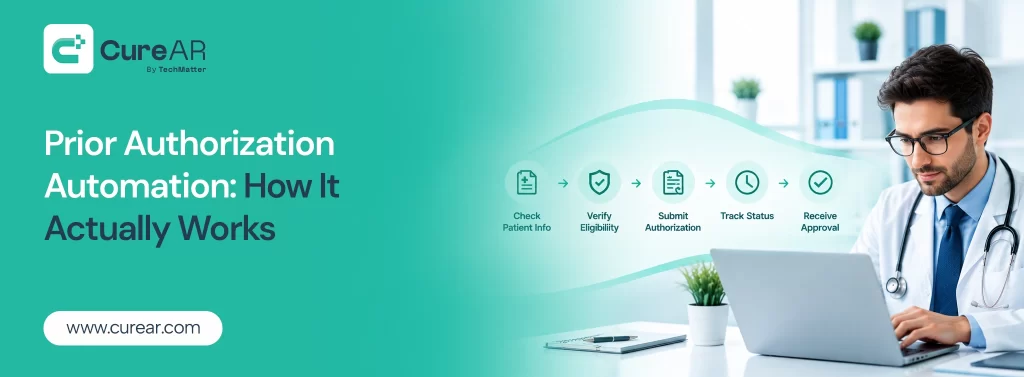
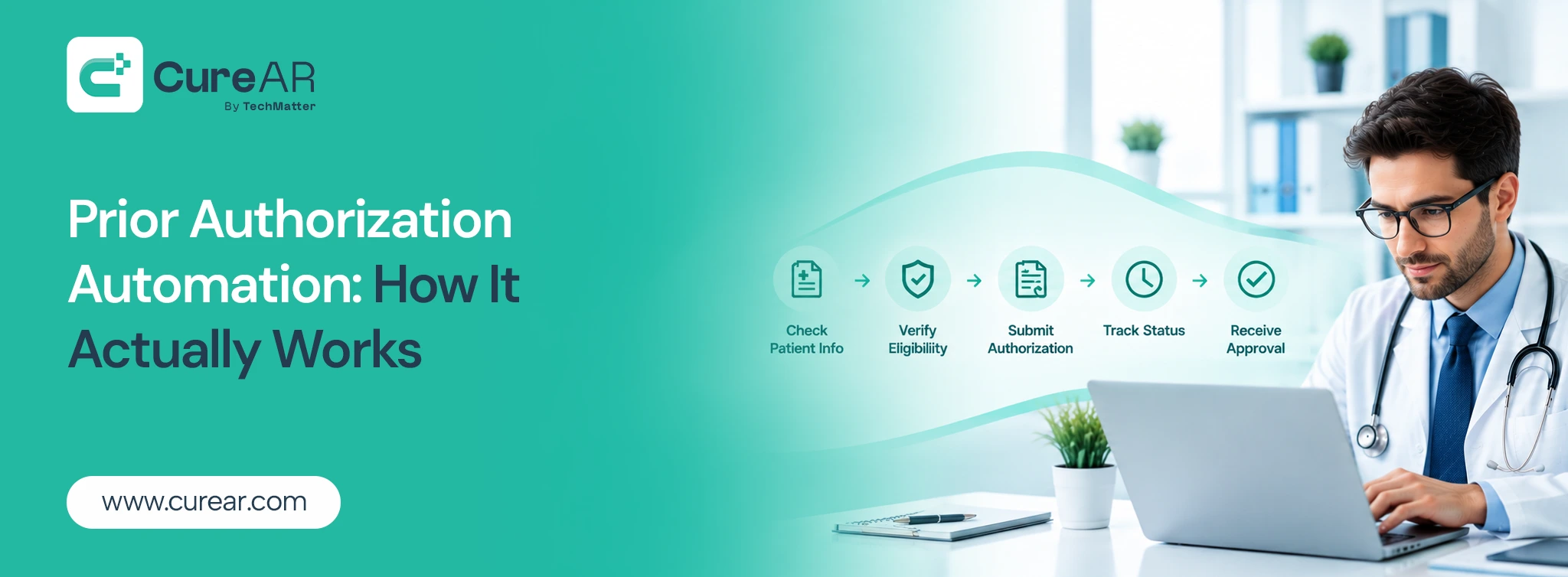
Strip away the marketing language, and automated prior authorization software covers three mechanical jobs nothing more.
Eligibility and requirement checking. Software checks, in real time, whether a given CPT/ICD-10 combination requires prior authorization for a specific payer, instead of staff relying on memory or a spreadsheet that’s three months out of date.
Structured submission. Request data patient, diagnosis, procedure, clinical justification is formatted and transmitted electronically rather than faxed or manually keyed into a payer portal.
Status tracking. The system shows where a request sits submitted, pending, additional information requested, approved, denied instead of that information living only inside a payer’s portal.
CMS has pushed payers toward faster, more structured exchange through the Interoperability and Prior Authorization Final Rule (CMS-0057-F), which set operational requirements including 72-hour turnaround for urgent requests and specific denial reasons regardless of submission method that took effect January 1, 2026, with fuller API requirements following in 2027. That regulatory push is why more of this exchange now happens through structured electronic prior authorization (ePA) rather than PDF forms and fax machines.
None of these three jobs involve deciding medical necessity. That decision is made by the payer, sometimes by an algorithm on their end and sometimes by a clinical reviewer. Automation on the provider side changes how fast and how cleanly the request gets there not what the payer decides to do with it once it arrives.
Step-therapy requirements complicate this further. Many payers require a patient to try and fail a cheaper treatment before approving a more expensive one, and that requirement typically has to be verified and documented as part of the prior authorization request itself. Automated prior authorization software can check whether a step-therapy rule applies and flag what documentation it needs but it can’t make the clinical case that a step-therapy exception is warranted for a specific patient. That argument, like a peer-to-peer review, still needs a physician who can speak to why the standard sequence doesn’t fit this particular case.
Payer portal fragmentation is the other piece automation genuinely helps with, and it’s worth naming directly: a multi-payer practice may be logging into ten or more separate portals, each with its own login, its own form fields, and its own status-tracking quirks. Structured submission collapses that into one interface on the practice’s side. That’s a real, measurable time saving it just isn’t the same thing as reducing how many of those requests eventually get denied.
The Misconception That Causes the Most Wasted Money
The most common assumption is that this kind of software handles approvals end-to-end, with no staff time required. It doesn’t, and vendors who imply otherwise are describing electronic submission, not judgment. Clinical documentation still has to be accurate and complete. Peer-to-peer reviews when a payer disputes medical necessity still require an actual conversation between a physician and a payer representative, something no software product performs on a practice’s behalf.
The AMA’s survey data makes this gap visible: only 24% of physicians report that medical necessity denials are consistently reviewed by an appropriately qualified clinician on the payer side, and just 16% say peer-to-peer reviewers are consistently qualified. Automating the provider’s submission process doesn’t touch either of those numbers, because they describe what happens on the payer’s side of the exchange, not the provider’s.
Buying software under the belief that it will make the practice’s denial rate fall dramatically gets the mechanism backwards. It flattens the submission-speed part of the curve while leaving the review-quality part the part actually driving denials completely untouched
How Long This Actually Takes to Pay Off
Implementing automated prior authorization software isn’t a switch-flip. Payer connections have to be configured, staff have to relearn a workflow they’ve done manually for years, and requirement rules which vary by payer and change without much notice need to be validated against real claims before anyone trusts the system.
Most practices see the submission-speed benefit almost immediately: requests go out same-day instead of sitting in a queue. The denial-rate benefit, if it comes, tends to show up over two to three billing cycles, once staff stop double-checking the automation out of habit and the requirement rules have been validated against enough real claims to trust.
There’s no honest version of this that promises a 90% reduction in prior authorization time in month one. Practices that get burned here usually bought into a timeline the vendor set, not one grounded in how long it actually takes staff to change behavior or in how slowly payers themselves are rolling out CMS-0057-F’s own compliance timeline, which stretches into 2027 for the API requirements.
The payer side of this timeline matters more than most practices give it credit for. CMS-0057-F’s operational requirements the 72-hour and 7-day turnaround windows, the specific denial-reason mandate only took effect January 1, 2026, and the full FHIR API build-out that’s supposed to make electronic prior authorization genuinely fast doesn’t come due until January 1, 2027 for most payer types. A practice that automates its own submission process in early 2026 may still be sending structured requests into payer systems that haven’t finished their side of the upgrade. The technology on the provider side can be ready well before the infrastructure on the receiving end catches up, and that gap shows up as slower-than-expected turnaround even when the practice has done everything right.
This is also where a practice’s own payer mix changes the math. A group weighted heavily toward Medicare Advantage is dealing with a payer category CMS-0057-F applies to directly, so the 2026 and 2027 deadlines are binding. A group weighted toward commercial plans outside the federally facilitated exchange may see slower voluntary adoption, since several of the rule’s provisions apply specifically to Medicare Advantage, Medicaid and CHIP managed care, and qualified health plans not to every commercial payer a practice deals with. Two practices implementing identical software can see meaningfully different timelines for exactly this reason, and neither one is doing anything wrong.
The One Constraint That Decides Whether Any of This Helps
Most conversations about this category get stuck on submission speed how many portals a tool logs into, how fast a request goes out. That’s the wrong place to look for the real payoff, because prior authorization is only one symptom of a bigger constraint: whether a practice knows a claim is likely to be denied before it leaves the building at all.
This is the idea behind what we call the Upstream Signal: the principle that the highest-leverage moment in the entire revenue cycle isn’t the prior authorization request, it’s the moment just before any claim is submitted, when a correction is still nearly free and a denial is still avoidable. PA workflow automation operates at one specific stage. The Upstream Signal operates one layer above it, across every stage.
This is deliberately where CureAR sits not as a prior-authorization tool, but as an AI-driven Revenue Cycle Management platform working one layer upstream of it. CureAR’s AI-driven denial management analyzes claims against historical approval and denial patterns before submission, flags what should be corrected first, and shows a claim’s approval-success rate alongside what additional information would raise it. That happens at the claim level, across the full revenue cycle not as a prior-authorization-specific workflow, and not as a submission tool that competes with a practice’s existing PA software.
The value isn’t fewer portal logins for PA requests. It’s catching the underlying documentation and coding issues the same issues that also happen to drive PA denials before a claim is ever sent anywhere, regardless of whether prior authorization was required for that claim at all.
Where Does Your Practice Actually Lose Time?
Portal-switching and manual submission are real friction, but they’re rarely the most expensive part of the problem. If you’re not sure whether your team is losing more time to slow submission or to claims that were destined to be denied from the start, that’s worth looking at directly. Schedule a conversation with CureAR to see where your specific claims are actually stalling.
What Doesn’t Fix This (and Why)
Adding more staff to handle PA volume. This scales cost linearly with request volume and does nothing to reduce how many requests get denied or delayed in the first place it just means more people manually catching the same category of error, faster.
Switching payer portals one at a time. This fixes friction with one payer while leaving the other eleven exactly as fragmented as before, and does nothing for the underlying documentation gaps causing denials across all twelve.
Generic fax-to-electronic conversion tools. These speed up transmission but carry the same incomplete clinical documentation forward, so denial rates barely move the format changed, the content quality didn’t.
Relying on staff memory for payer-specific requirements. Requirements change without much notice, and memory doesn’t get flagged when a rule updates; the practice finds out only after a denial, by which point the thirteen hours of staff time are already spent.
Reviewing claim quality only after a denial comes back. By then the damage is done and the same documentation gaps repeat on the next claim, because nothing upstream of submission actually changed.
Treating this as purely a payer-behavior problem. Payer scrutiny has genuinely increased three in four physicians report denials rising over the past five years, per the same AMA survey but a practice waiting for payers to get easier is waiting for a trend that’s moving in the opposite direction.
Waiting on a gold-card exemption instead of fixing the workflow. It’s tempting to treat a state gold-carding law as the eventual fix earn the exemption, stop worrying about that service category. In Texas, the state furthest along on this, only about 3% of providers have actually qualified. Betting a practice’s time budget on an exemption that most providers never reach means the underlying denial-risk visibility problem sits there unaddressed while the practice waits for a threshold it may never clear.
Each of these treats a symptom slow submission, staff overload, an unpredictable payer without touching the part that actually costs money: not knowing a claim was high-risk until the payer says so.
Frequently Asked Questions
No. It speeds up and structures the request. The payer still decides, and the AMA’s own data shows nearly one in three requests are still often or always denied regardless of how the request was submitted.
ePA (electronic prior authorization) is the data-exchange standard CMS is pushing payers toward under CMS-0057-F. PA automation is the practice-side software that uses that standard to submit and track requests without manual re-entry.
No. Peer-to-peer review is a clinical conversation between physicians; software can’t stand in for it, and only 16% of physicians report those reviewers are consistently qualified in the first place.
Submission speed improves almost immediately. Denial-rate improvement typically takes two to three billing cycles to show clearly
No. It removes repetitive data entry and portal-switching so staff can spend their time on the claims and requests that actually need judgment.
Upstream of PA entirely: at claim-level denial risk. A claim that’s flagged and corrected before submission avoids the PA delay, the denial, and the resubmission cycle all at once.
No. CureAR is an AI-driven Revenue Cycle Management platform that scores claim-level denial risk before submission, across the full revenue cycle. It doesn’t submit, track, or automate PA requests — that’s a different, adjacent category of software.
Where This Leaves the Decision
Prior authorization automation is a real, useful category and a genuinely limited one. It replaces manual, repetitive submission and status-tracking work with structured, trackable data exchange. It does not replace clinical judgment, peer-to-peer conversations, or a payer’s right to deny a claim, and the AMA’s own survey data shows those limits haven’t moved even as more of the process goes electronic.
The bigger opportunity for most practices sits one layer earlier than prior authorization altogether: knowing, before any claim is submitted, whether it’s likely to run into trouble. That’s the layer worth evaluating a platform on not how many portals it can log into.
See Where Your Claims Actually Stand
If your team is finding out about denial risk after the fact, that’s a visibility problem upstream of prior authorization. Schedule a demo with CureAR to see how AI-driven denial management flags risk before a claim leaves your practice.