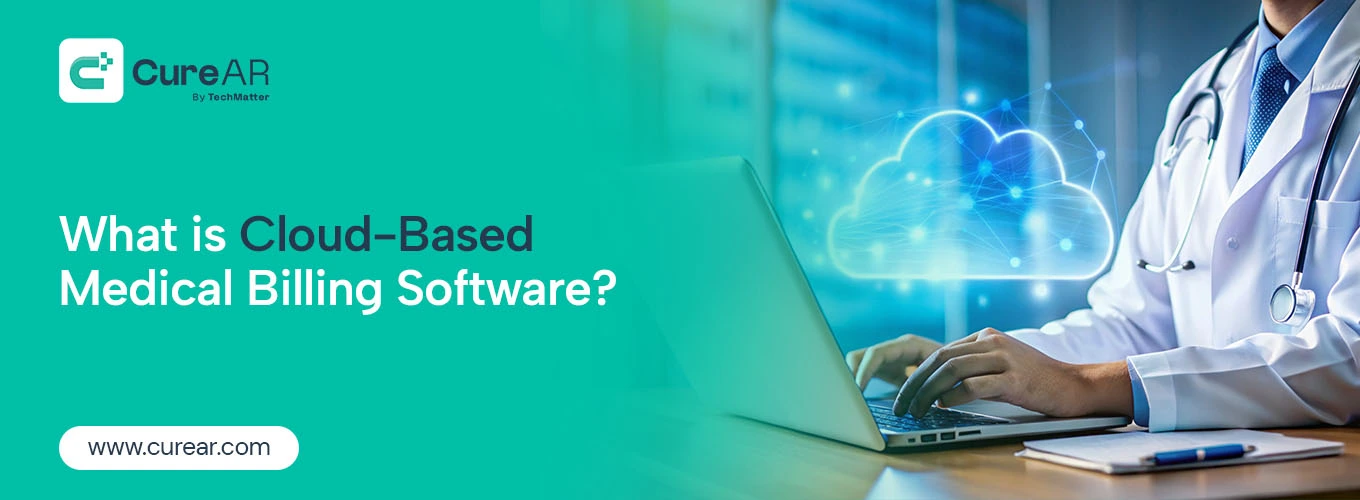
As the healthcare software industry evolves, cloud-based medical billing software simplifies and automates the complex billing process. Replacing paper-based systems with cloud-based infrastructure streamlines claims, ensures data accuracy, and enhances payment tracking. These tools help providers save time, reduce errors, and improve their revenue cycle efficiency, allowing them to focus more on patient care.
Cloud-based Medical Billing Software: What You Need to Know
Cloud-based medical billing software is a web-hosted platform that allows healthcare providers to manage their entire billing and revenue cycle online without relying on local servers or manual systems.
Instead of storing data on-site, all billing information, patient records, and claims are securely stored in the cloud, enabling real-time access from anywhere. This technology streamlines operations like claims submission, payment posting, denial management, and reporting, while automatically updating with the latest payer rules and compliance standards (such as HIPAA).
Essential Elements of Cloud-based RCM Software
Efficiency in billing processes is more critical than ever in today’s rapidly changing healthcare ecosystem. Cloud-based medical billing software like Cure AR provides healthcare teams with secure, remote access to patient data, claims, and payments, far surpassing traditional billing methods in both speed and reliability.
With automation, real-time reporting, and a unified data platform, providers can streamline administrative workflows and make smarter financial decisions. This increased accessibility leads to improved revenue cycle management, faster claim processing, and enhanced patient care. For growing practices, virtual billing has become an indispensable tool for scalability and success.
Advantages of Cloud-based Medical Billing Software
Integrating cloud-based billing solutions into your practice offers a wide range of benefits, from greater revenue cycle management (RCM) visibility to stronger financial performance.
Improved Interoperability and Instantaneous Cooperation
Certain cloud-based systems create a unified workflow by smoothly integrating with other practice management software and EHRs (electronic health records). Errors across systems are reduced, and patient care is simplified by this interconnectedness.
Whether a medical assistant is on-site or a billing coordinator working remotely, cloud-based tools guarantee that many users can collaborate efficiently.
For instance, some cloud-based medical billing software integrates with your practice EHRs to protect the accuracy and privacy of patient data. Additionally, integration makes it possible for the billing and clinical departments to communicate easily.
Advanced Reporting and Analytics
Platforms for cloud billing provide powerful reporting and analytics capabilities. With the help of these technologies, providers may monitor key performance indicators, generate customized reports, and get a comprehensive picture of their financial health.
These insights enable practices to make well-informed decisions that will increase the effectiveness of their revenue cycle operations.
Compliance and Cost-Effectiveness
With cloud-based solutions, you can eliminate the need for expensive IT maintenance and upfront hardware investments associated with on-premise systems. Think about these costs:
- Hardware, software licenses, IT infrastructure, and installation fees are upfront expenses.
- Continuous operating costs include updates, cooling, hardware maintenance, and electricity.
- Maintenance includes hiring more IT personnel, providing training, and maintaining software. Because cloud-based solutions work on a pay-as-you-use or subscription basis, even smaller practices can afford sophisticated technology.
How much can be saved by using this technology instead? For instance, according to recent research, a large health institution with over 24,000 staff will save millions of dollars a year by moving to the cloud.
In-House Systems vs. Cloud Billing
The primary difference between in-house billing and cloud-based systems is maintenance, pricing, accessibility, and hosting.
Cloud-Based Software
Cloud-based medical billing software can be accessed online and is run and maintained by the software supplier. Data is safely saved in the cloud and is automatically updated, making it expandable and extremely accessible. There are often no upfront hardware expenditures, and payments are made as part of a monthly or yearly subscription arrangement.
In-House Software
This requires constant IT upkeep, frequent manual updates, and hardware configuration within a clinic or organization. Although they provide some protection and data control, they frequently fall short of cloud solutions in terms of efficiency and flexibility. Costs usually include an initial software and hardware investment, as well as ongoing IT and maintenance expenses.
Providers may discover that switching to a cloud-based solution allows them to concentrate on patient care rather than administrative and IT challenges. Your practice may change as a result of this release from the daily grind of operations.
The Future of Healthcare Billing
The future of healthcare billing is rapidly moving toward a fully digital, cloud-based, AI-driven ecosystem. Billing software like Cure AR is designed to optimize efficiency, accuracy, and financial transparency. As automation, machine learning, and predictive analytics become more deeply embedded into healthcare operations, billing will evolve from a reactive process into a proactive, insight-based function.
Cloud-based platforms will not only handle claims processing but also forecast denials, identify coding errors, and suggest optimizations in real time. This transformation will help providers make smarter financial decisions while ensuring faster reimbursements and fewer administrative bottlenecks.
Moreover, the integration of blockchain and advanced encryption will redefine data security, giving both patients and providers greater trust in digital systems. As healthcare organizations grow and patient volumes increase, many will outsource medical billing to specialized providers who can utilize future-ready tools, AI technology, and compliance expertise to manage the entire revenue cycle efficiently.
This outsourcing trend will allow medical professionals to focus on delivering quality patient care, while their billing operations are managed by experts who understand the evolving regulations and payer requirements. In the coming years, healthcare billing will no longer just be a back-office process; it will be a strategic pillar driving operational success, financial growth, and better patient outcomes.
Frequently Asked Questions
Medical billing software is a web-based platform that allows healthcare providers to manage billing, claims, and revenue cycle operations online. It securely stores data in the cloud, enabling real-time access, automatic updates, and seamless integration with EHR systems without the need for on-premise servers or manual maintenance.
Unlike traditional systems that require expensive hardware, manual updates, and dedicated IT staff, web-based billing software operates online under a subscription model. It offers scalability, remote accessibility, automated updates, and enhanced security, helping practices save time and reduce operational costs.
Yes. Most cloud-based billing systems use advanced encryption, multi-factor authentication, and HIPAA-compliant data protection protocols. This ensures that sensitive patient and financial information remains secure and accessible only to authorized personnel.
Key benefits include improved revenue cycle management, faster claims processing, reduced billing errors, cost savings on IT infrastructure, and enhanced collaboration between billing teams and clinical staff. It also allows healthcare professionals to focus more on patient care instead of administrative burdens.
Absolutely. Many healthcare organizations choose to outsource medical billing services to specialized providers who use cloud-based systems. This approach ensures expert management of claims, faster reimbursements, compliance with regulations, and improved overall financial performance while freeing providers to prioritize patient care.