

In medical billing, revenue is rarely lost because of one major error. It usually disappears quietly through missed charges, underpaid claims, delayed postings, or small discrepancies that go unnoticed for months. Reconciliation is the process that stops those leaks. It ensures that every service provided is billed correctly and that every dollar owed is properly accounted for. Reconciliation is no longer just a back-office task in today’s high-denial, audit-heavy healthcare environment. It has transformed into a financial safeguard that protects revenue, strengthens compliance, and brings control to increasingly complex billing operations.
What Medical Reconciliation Really Means in Practice
Medical reconciliation is the structured process of comparing clinical documentation, billing records, and payer payments to ensure they match at every stage. It connects what happened during patient care with what appears on claims and, ultimately, what is reflected in financial reports.
In practice, reconciliation focuses on answering three critical questions:
- Was the service actually delivered and documented?
- Was it billed accurately using the correct codes and modifiers?
- Was the expected payment received based on payer contracts?
When even one of these steps is misaligned, financial issues follow. A documented service that was never charged leads to lost revenue. A correctly billed claim that was underpaid leads to silent margin erosion if it is not reviewed. Over time, these small issues add up.
The Centers for Medicare & Medicaid Services (CMS) consistently highlights that documentation and billing inconsistencies are among the leading causes of improper payments across healthcare programs. Reconciliation serves as a primary control to identify and correct these gaps early.
Why Reconciliation in Billing is Non-Negotiable
Healthcare organizations operate under increasing financial pressure. Reimbursement rates are tightening, payer rules are changing, and audits are becoming more frequent and more detailed. In this environment, reconciliation is not optional. It is essential.
Reconciliation protects organizations by:
- Identifying underpayments that would otherwise go unnoticed
- Catching billing errors before they turn into denials
- Supporting compliance through consistent financial oversight
- Providing accurate data for budgeting and forecasting
Without reconciliation, billing teams often operate reactively. Problems are discovered months later, when recovery is difficult or impossible. With reconciliation in place, issues are identified quickly and addressed before they impact cash flow.
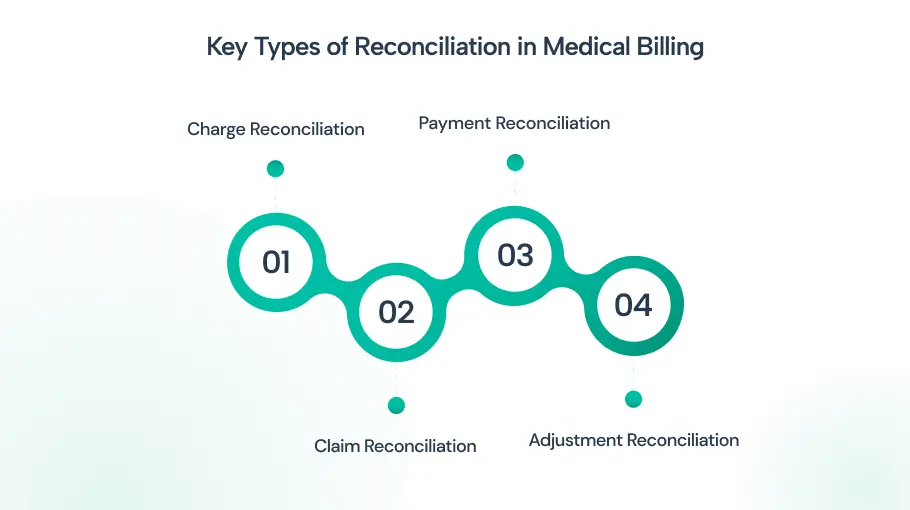
Key Types of Reconciliation in Medical Billing
Reconciliation is not a single task performed at month-end. It occurs throughout the revenue cycle, with each type serving a specific purpose.
Charge Reconciliation
Charge reconciliation confirms that all services documented in clinical records have been translated into billable charges. This step is critical because missing charges are one of the most common and preventable causes of revenue loss. Even a small percentage of missed charges can result in significant annual losses.
Claim Reconciliation
Once charges are submitted, claim reconciliation tracks their status. It ensures claims are received by payers, identifies rejections, and flags claims that require correction or resubmission. This step helps prevent claims from aging unnoticed.
Payment Reconciliation
Payment reconciliation compares payer payments against expected reimbursement amounts. It is used to identify underpayments, incorrect bundling, and payment variances tied to contract terms. This step directly protects revenue by ensuring organizations are paid what they are contractually owed.
Adjustment Reconciliation
Adjustments and write-offs are reviewed to confirm they are appropriate and compliant with payer contracts. This prevents unnecessary revenue loss due to incorrect or excessive adjustments.
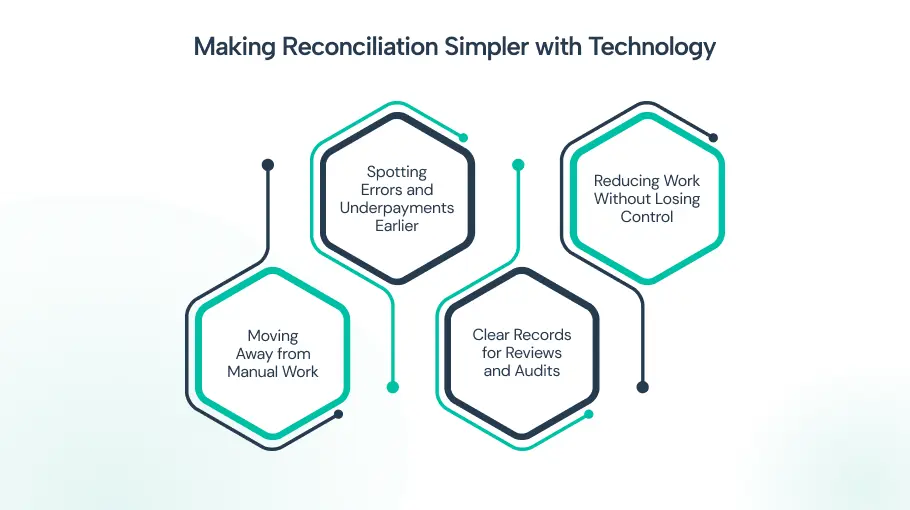
Making Reconciliation Simpler with Technology
Reconciliation can quickly become overwhelming when handled manually, especially as claim volumes grow and payer rules change. Technology helps bring order to the process by making data easier to track, compare, and review. Instead of chasing information across systems, teams can see the full picture in one place and act faster when something does not add up.
- Moving Away from Manual Work
Manual reconciliation often relies on spreadsheets, emails, and individual follow-ups. This approach leaves room for missed details and delays. Technology helps standardize reconciliation by organizing charges, claims, and payments into a clear workflow that is easier to manage and review.
- Spotting Errors and Underpayments Earlier
When systems automatically compare what was billed with what was paid, problems are easier to catch. Missing charges, unpaid claims, or lower-than-expected payments stand out sooner. This allows billing teams to fix issues before they turn into larger revenue losses.
- Clear Records for Reviews and Audits
Technology-supported reconciliation creates clear records of each step, from claim submission to payment posting and adjustments. This makes it easier to answer payer questions, prepare for audits, and maintain confidence in financial reports.
- Reducing Work Without Losing Control
The goal of technology is not to replace reconciliation, but to make it easier to manage. Tools like CureAR, an AI-enabled medical billing software, support reconciliation by highlighting issues that need attention while reducing manual effort for billing teams.
Common Reconciliation Gaps That Cost Providers Money
Even experienced billing teams encounter reconciliation challenges. These issues often stem from process gaps rather than a lack of effort.
Common challenges include:
- Incomplete or delayed clinical documentation
- Late or unclear remittance advice from payers
- Complex contracts with varying reimbursement rules
- High claim volumes with limited review capacity
When reconciliation is inconsistent, these gaps compound. What begins as a minor discrepancy can evolve into widespread revenue leakage, compliance exposure, or reporting inaccuracies.
Best Practices for Strong, Consistent Reconciliation
Effective reconciliation requires structure, consistency, and accountability. The most successful organizations treat it as an ongoing discipline rather than a periodic task.
Best practices include:
- Performing charge reconciliation daily or weekly
- Establishing standardized workflows across billing and finance teams
- Maintaining up-to-date payer contract and fee schedule data
- Using exception-based reviews to focus on high-risk discrepancies
- Training staff to understand both clinical and financial data
Academic institutions support this approach. The University of Michigan School of Public Health notes that proactive financial controls, including reconciliation, are essential for maintaining operational stability and long-term sustainability in healthcare organizations.
Conclusion
Reconciliation is one of the most effective tools in medical billing for protecting revenue and maintaining financial accuracy. It provides visibility into complex workflows, prevents silent revenue loss, and supports compliance in an increasingly regulated environment. Organizations that prioritize reconciliation as a routine, structured process are better equipped to stay financially stable, audit-ready, and in control of their revenue cycle.
Frequently Asked Questions
It is the process of making sure services provided, claims submitted, and payments received all match.
Charge and claim reconciliation should be done weekly, while payment reconciliation should occur as payments are received.
Responsibility is typically shared between billing, finance, and revenue cycle teams.
Yes. Consistent reconciliation creates a clear audit trail and reduces compliance risk.
Absolutely. Small discrepancies can have a significant impact on cash flow for smaller organizations.