

In medical billing, receiving a payment is only part of the reimbursement process. What truly matters is understanding how that payment was calculated, what adjustments were applied, and whether the remaining balance is accurate. This is where the Explanation of Benefits (EOB) and Electronic Remittance Advice (ERA) come into play.
Both documents serve as detailed payment explanations issued after a claim is processed, yet they differ significantly in format, delivery, and usage. For providers, billing teams, and healthcare administrators, understanding ERA and EOB in medical billing is essential for accurate posting, denial management, and patient billing.
What is an Explanation of Benefits (EOB)?
An Explanation of Benefits (EOB) is a statement generated by an insurance payer after processing a healthcare claim. It explains how the claim was evaluated and outlines the financial responsibility of each party involved. Although patients often receive EOBs, providers also rely on them to verify claim outcomes.
An EOB details the original charge submitted by the provider, the amount approved by the payer under the patient’s plan, and any reductions applied due to contractual agreements. It also explains why certain services may not have been covered and clearly identifies what portion, if any, the patient owes.
What an EOB typically includes:
- Patient name and policy details
- Provider and service information
- Amount billed by the provider
- Amount allowed by the payer
- Adjustments (contractual write-offs, denials, reductions)
- Amount paid by insurance
- Patient responsibility (copay, deductible, coinsurance)
An EOB is not a bill. Instead, it’s a breakdown that helps providers and patients understand how the claim was adjudicated.
For patients, EOBs answer the question: “Why do I owe this amount?”
For providers, they help identify underpayments, denials, or errors that need follow-up.
What is Electronic Remittance Advice (ERA)?
Electronic Remittance Advice (ERA) is the digital counterpart to a traditional paper EOB. Delivered in a standardized electronic format, ERA files are sent directly from the payer to the provider’s billing system, usually alongside electronic payments.
ERAs are designed to be read by software rather than humans. They contain detailed payment data, including claim statuses, adjustment codes, and patient responsibility amounts. Because the data is structured, ERAs allow billing systems to automatically post payments without manual entry.
What ERA includes:
- Claim-level payment details
- Reason and adjustment codes
- Paid, denied, or partially paid statuses
- Patient responsibility amounts
- Check or EFT reference numbers
Unlike EOBs, ERAs are designed for automation, not manual review.
For practices handling large claim volumes, ERAs significantly reduce administrative workload and posting errors. When discussing ERA and EOB in medical billing, ERA is often seen as the operational backbone that keeps revenue cycles efficient and timely.
ERA vs. EOB: What’s the Difference between the Two?

Although ERA and EOB contain similar payment information, their purpose and usability differ. An EOB is primarily intended for explanation and transparency, making it easier for patients and staff to review claim outcomes. ERA, on the other hand, is built for automation and speed.
EOBs typically arrive days or weeks after a claim is processed, while ERAs are often delivered electronically within hours. This timing difference directly affects cash flow, as ERAs allow payments to be posted quickly and accurately. For billing teams, this distinction is critical when reconciling accounts and identifying unpaid claims.
Understanding these differences helps organizations choose the right tools and workflows for managing ERA and EOB in medical billing environments.
Why ERA and EOB Are Critical to the Revenue Cycle
Both documents play a vital role in ensuring financial accuracy across the revenue cycle. Without them, providers would have little insight into how reimbursements are calculated or why claims are denied.
ERAs streamline internal operations by allowing automated posting and faster reconciliation. EOBs support transparency and communication, especially when patients question balances or coverage decisions. Together, they provide a complete financial picture that supports compliance, auditing, and revenue optimization.
Healthcare organizations using modern systems, especially those integrated with cloud-based medical billing software, are better equipped to manage ERA data efficiently while retaining EOBs for reference and patient education.
Common Issues Providers Face With ERA and EOB
Despite their benefits, ERA and EOB processing is not without challenges. Missing adjustment codes, incorrect payer mappings, or misconfigured software can lead to posting errors. EOBs may arrive late or contain unclear explanations, creating confusion for patients and staff alike.
When ERA data does not match deposited payments, billing teams must perform manual reconciliation, which can slow down operations. These issues highlight the importance of regular audits and staff training to ensure data accuracy and consistency.
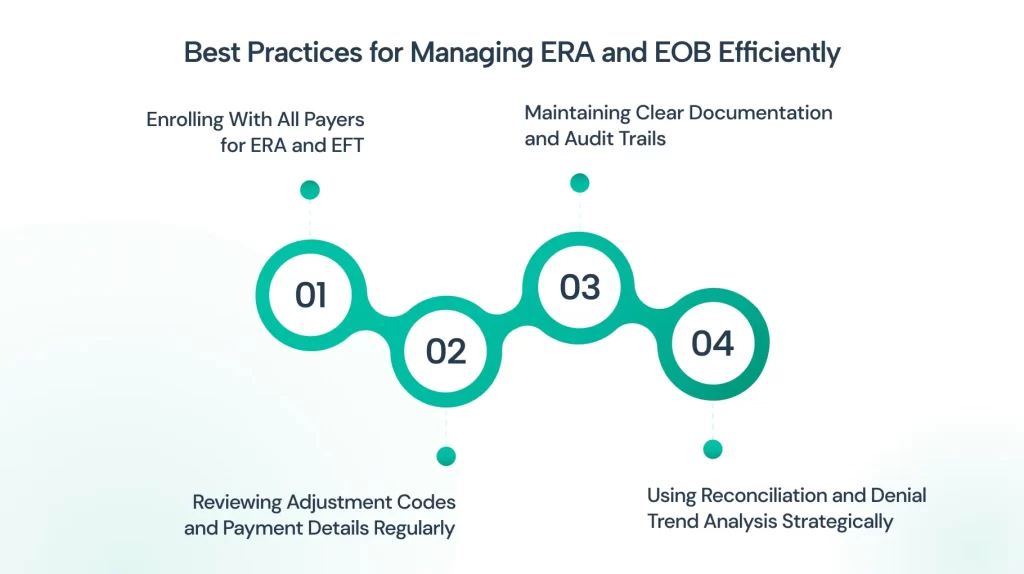
Best Practices for Managing ERA and EOB Efficiently
Healthcare organizations that manage remittance data proactively are far more likely to maintain accurate financial records and stable cash flow. Establishing structured workflows around both ERA and EOB processing reduces errors, shortens follow-up cycles, and improves overall billing performance. Here are some best practices that help manage ERA and EOB effectively.
Enrolling With All Payers for ERA and EFT
One of the most effective steps a practice can take is enrolling with all contracted payers for Electronic Remittance Advice and Electronic Funds Transfer. ERA enrollment ensures that payment details are delivered electronically and consistently, while EFT allows funds to be deposited directly into the provider’s account. Together, these two processes eliminate delays caused by paper checks and manual posting, helping billing teams reconcile payments faster and with greater accuracy.
Reviewing Adjustment Codes and Payment Details Regularly
Adjustment and reason codes included in ERA and EOB documents explain why payments were reduced, denied, or partially approved. Regularly reviewing these codes allows billing teams to identify recurring issues such as coding errors, authorization gaps, or contract discrepancies. Over time, this insight helps organizations correct patterns that lead to underpayments and prevent repeat denials.
Maintaining Clear Documentation and Audit Trails
Accurate documentation is essential when managing remittance advice. Keeping clear records of EOBs, ERA files, and payment reconciliations supports internal audits and strengthens appeal cases when payer decisions are disputed. Well-maintained documentation also ensures compliance with payer and regulatory requirements, reducing the risk of revenue loss due to missing or incomplete records.
Using Reconciliation and Denial Trend Analysis Strategically
Routine reconciliation of ERA data against deposited payments helps practices catch mismatches early before they impact financial reporting. When combined with denial trend analysis, reconciliation becomes a strategic tool rather than a reactive task. By understanding why claims fail or pay incorrectly, organizations can refine their billing processes, improve claim accuracy, and ultimately turn ERA and EOB data into drivers of long-term revenue growth.
Final Thoughts
Explanation of Benefits and Electronic Remittance Advice are foundational to accurate reimbursement and financial transparency in healthcare. While EOBs focus on clarity and communication, ERAs emphasize speed and automation. Together, they support a reliable and efficient revenue cycle.
A strong understanding of ERA and EOB in medical billing empowers providers to reduce denials, improve patient trust, and maintain financial stability in an increasingly complex healthcare environment.
Frequently Asked Questions
An EOB is a paper or PDF document that explains how a claim was processed, while an ERA is an electronic file used by billing systems to automatically post payments.
Payers are required to provide remittance information explaining claim decisions. ERA is the standard electronic format used by most payers, especially government programs.
ERA can handle most internal billing tasks, but EOBs are still useful for patient explanations, audits, and claim disputes.
Providers should reconcile the ERA with the EFT and review adjustment codes to identify missing or incorrect payments.
It helps providers post payments accurately, manage denials, and bill patients correctly, leading to better cash flow and fewer disputes.