

At its core, a clearinghouse acts as a digital claims middleman between healthcare providers and payers. Think of it as a quality control checkpoint where claims are verified, scrubbed, and prepared for submission according to payer rules.
Clearinghouses translate claims from your practice management or billing system into standardized formats that insurance companies accept. They also notify you of errors before a claim reaches the payer, which dramatically reduces denials, resubmissions, and payment delays.
The Basic Definition
A clearinghouse in medical billing is a third-party organization that receives electronic claims from healthcare providers, checks them for errors or compliance issues, and submits them to the appropriate insurance payers. The goal is to ensure that claims are accurate, complete, and formatted to meet each payer’s requirements.
Why They’re Used
Without a clearinghouse, medical billers would have to submit claims individually to dozens of payers, each with its own set of rules, formats, and requirements. A clearinghouse consolidates this complexity, allowing you to send claims through a single portal rather than multiple direct submissions.
How It Works
- Claim Submission: Your billing system generates an electronic claim.
- Error Checking (Claim Scrubbing): The clearinghouse analyzes the claim for coding mistakes, missing data, and payer-specific rule violations.
- Formatting: The claim is converted into a standard format (like ANSI X12) understood by the payers.
- Forwarding to Payer: The cleared and formatted claim is sent to the correct insurance company.
- Acknowledgment and Reporting: The clearinghouse sends back status updates, confirming receipt, rejection, or acceptance.
This process speeds up claim cycle times and improves first-pass acceptance rates.
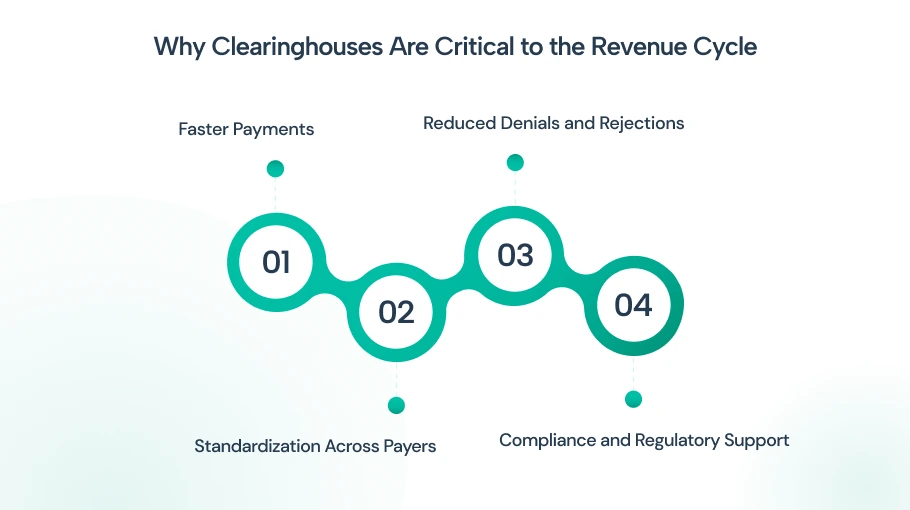
Why Clearinghouses Are Critical to the Revenue Cycle
Healthcare revenue cycle success is a numbers game: get claims accepted quickly, avoid rework, reduce denials, and improve cash flow. The clearinghouse plays a central role in each of these areas.
Clearinghouses help practices shift from reactive billing, where problems are resolved after denial, to proactive billing, where errors are fixed before submission.
Faster Payments
By catching and correcting issues before claims reach the payer, clearinghouses increase the chances of first-pass acceptance. Faster acceptance means faster payment, which translates directly into healthier cash flow.
Reduced Denials and Rejections
Claim denials can be expensive. They cost time to rework and delay cash flow. A clearinghouse minimizes these by flagging issues early, giving billers a chance to correct them before resubmitting.
Standardization Across Payers
Each payer has unique formatting requirements. A clearinghouse standardizes claims into a format payers commonly accept, so you don’t need to build custom pipelines for each insurer.
Compliance and Regulatory Support
Clearinghouses often maintain up-to-date knowledge of regulatory changes, such as HIPAA standards, ensuring that claims comply with federal requirements as well as payer rules. The U.S. government’s Health Information Technology for Economic and Clinical Health (HITECH) Act and related HIPAA provisions emphasize secure and standardized electronic transactions, which clearinghouses help enforce.
Clearinghouse Features That Make a Difference
Not all clearinghouses are created equal. The best ones not only transmit claims but add layers of intelligence that streamline the billing process.
Here are the most valuable features to look for:
Automatic Claim Scrubbing
This is the heart of what makes clearinghouses so valuable. Automated rules check for common errors (missing patient data, invalid codes, and improper formats) and alert billers before the claim is sent forward.
Real-Time Error Alerts
A strong clearinghouse doesn’t just flag errors. It notifies billers immediately so corrections can be made on the spot, reducing cycle time and frustration.
Batch Submissions
Instead of sending individual claims one by one, your clearinghouse can group them and send them in batches. This saves time and bandwidth for large practices with high claim volumes.
Reporting and Analytics
Advanced clearinghouses provide dashboards that show claim status, trends in denials, and performance metrics. This data helps you identify persistent problem areas and improve internal processes.
Payer Connectivity
The strength of a clearinghouse is also measured by the number of payer connections it supports. More connections mean your clearinghouse can route claims to a broader range of insurers without additional setup.
Integration with Your Systems
Seamless integration with your practice management system or EHR ensures that claims are passed automatically to the clearinghouse without manual entry.
A good example of industry evolution is how clearinghouses have supported electronic data interchange (EDI), which the federal government requires for standardized billing formats. Practices that leverage EDI through their clearinghouses benefit from both speed and compliance efficiency.
Clearinghouse vs. Direct Payer Submission: Why It Matters
Some practices attempt to bypass a clearinghouse and submit directly to payers. While direct submission is possible, it’s rarely worth the trade-offs.
Clearinghouses solve problems before they occur, whereas direct submissions often uncover them after the payer rejects the claim.
Why Direct Submissions Fall Short
- Manual handling increases the risk of error.
- Each payer has its own format requirements.
- Denials take longer to resolve without early quality checks.
Clearinghouses Save Time and Money
Consider this: a claim rejected due to a formatting issue can take hours or days to fix and resubmit. With a clearinghouse, that same issue is caught before it ever leaves your office, saving time and protecting revenue.
What Practices Lose Without a Clearinghouse
If your office is not using a clearinghouse, you’re likely paying a hidden cost, even if it feels like you’re saving money by skipping one.
- More Denials and Longer Follow-Up Times
Errors that might have been flagged early become denials that must be corrected, tracked, and resubmitted, consuming valuable staff hours.
- Lower First-Pass Acceptance
Without pre-submission scrubbing, many claims are rejected on the first pass, slowing the billing cycle and delaying revenue.
- Higher Administrative Burden
Manual claim preparation and follow-up create bottlenecks that distract your team from higher-value tasks like patient service and account follow-ups.
In contrast, practices that use a smart clearinghouse often see measurable improvements in turnaround time and decreased administrative overhead.
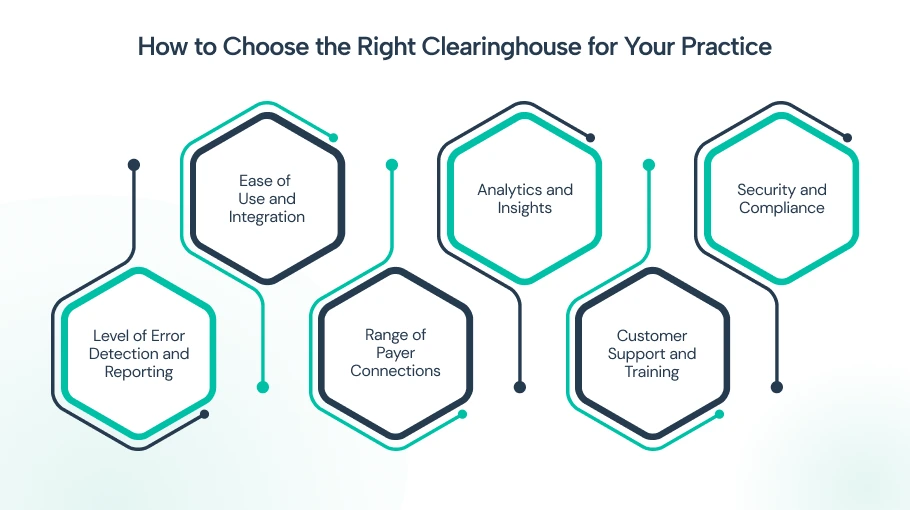
How to Choose the Right Clearinghouse for Your Practice
Selecting a clearinghouse is a strategic decision, not just a checkbox in your technology stack. Here are the most important factors to consider:
- Level of Error Detection and Reporting
Not all clearinghouses catch the same types of problems. Look for one with robust scrubbing logic and real-time reporting that provides clear explanations of errors.
- Ease of Use and Integration
Your clearinghouse should integrate seamlessly with your existing practice management system. If claims are exported manually or require extra steps, you’re not gaining efficiency.
- Range of Payer Connections
A wider network means more payers supported and fewer custom configurations. This is especially important if you serve patients with a diverse set of insurance plans.
- Analytics and Insights
Basic clearinghouses only transmit claims; advanced ones help you understand trends in denials, data quality, and payer response time. Some even integrate with medical billing clearinghouse software that elevates analytics and workflow automation.
- Customer Support and Training
When issues arise, and they inevitably will, responsive support makes all the difference. Look for a partner that offers training, onboarding assistance, and ongoing support.
- Security and Compliance
Because clearinghouses handle sensitive patient data, they must comply with HIPAA and other federal standards. Security safeguards, encryption, and regular audits should be non-negotiable.
The Future of Clearinghouses in Medical Billing
Clearinghouses are evolving rapidly. What was once simply a claims router is now becoming a hub for data intelligence, automation, and workflow optimization. Advanced platforms are using machine learning to predict common errors, automate corrections, and integrate more deeply with EHRs and practice management systems.
As healthcare continues to embrace digital transformation, the clearinghouse will play an even larger role in revenue cycle optimization, especially as practices pursue faster payments and better data insights.
Conclusion
In an industry where every denied claim costs time and every delay impacts cash flow, clearinghouses in medical billing have moved from “nice to have” to “essential.” They reduce errors, speed payments, and help practices stay compliant with payer and federal requirements.
Whether you’re a small clinic or a large multispecialty practice, understanding and using an effective clearinghouse can dramatically improve your revenue cycle performance.
Frequently Asked Questions
A clearinghouse helps reduce claim errors and ensures claims are sent correctly to insurance payers.
Healthcare providers, billing companies, and medical practices use clearinghouses to manage claim submissions.
Most practices benefit from using one, especially when submitting electronic claims to multiple insurance companies.
Yes, it reviews claims for errors before submission, which lowers the chances of rejection.
Some clearinghouses integrate with billing software, while others operate as separate platforms.