
Medical billing is no longer a back-office function; it’s a revenue engine. As payer rules tighten, reimbursement timelines shrink, and administrative costs rise, healthcare practices can no longer afford billing systems that simply “process claims.”
They need systems that think, flag, analyze, and adapt.
That’s where modern cloud-based medical billing software features stand apart. These platforms don’t just move billing online; they fundamentally change how practices manage risk, accuracy, and cash flow.
This guide breaks down the most critical features in depth, explaining not just what they do, but why they matter and how they directly impact revenue.
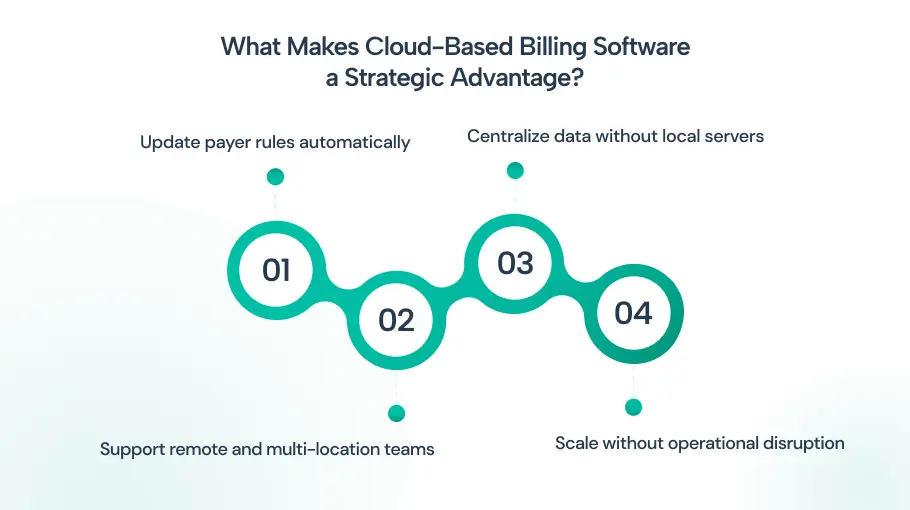
What Makes Cloud-Based Billing Software a Strategic Advantage?
Cloud-based medical billing platforms are hosted on secure servers and accessed through web-based environments. This allows billing teams, administrators, and leadership to work from anywhere with real-time visibility into financial performance.
Unlike legacy systems, cloud platforms:
- Update payer rules automatically
- Support remote and multi-location teams
- Centralize data without local servers
- Scale without operational disruption
The true value of cloud systems lies in how intelligently they manage complexity across the revenue cycle.
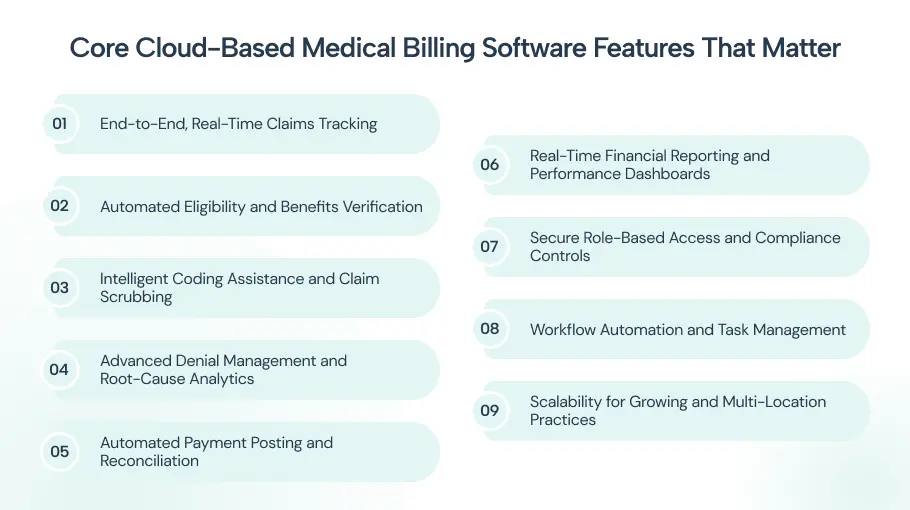
Core Cloud-Based Medical Billing Software Features That Matter
These core cloud-based medical billing software features form the foundation of an efficient, resilient revenue cycle. Together, they determine how effectively a billing system supports accuracy, compliance, and long-term financial performance.
1: End-to-End, Real-Time Claims Tracking
Delayed visibility leads to delayed action. When claims stall unnoticed, days in A/R climb, follow-ups become reactive, and revenue leaks quietly.
According to the Centers for Medicare & Medicaid Services (CMS), timely claim monitoring is essential for preventing avoidable reimbursement delays and denials.
Enter: Real-time claims tracking. This is one of the most critical cloud-based medical billing software features, and one of the most underestimated.
Instead of waiting for batch reports or payer correspondence, modern platforms allow billing teams to track each claim across its entire lifecycle:
- Submission
- Acceptance
- Rejection
- Payment
- Denial
- Appeal
2: Automated Eligibility and Benefits Verification
Eligibility-related denials are among the most preventable and costly billing errors. Advanced cloud platforms verify patient eligibility in real time, pulling coverage data directly from payers before services are rendered.
These systems check:
- Active coverage status
- Policy effective dates
- Copays and deductibles
- Service-specific limitations
Front-end eligibility verification reduces downstream denials, patient billing disputes, and write-offs tied to coverage misunderstandings.
3: Intelligent Coding Assistance and Claim Scrubbing
High-performing cloud systems go far beyond basic error checks. They use intelligent rules engines to analyze claims against:
- CPT/ICD compatibility
- Modifier usage
- Payer-specific billing rules
- National Correct Coding Initiative (NCCI) edits
This feature helps billing teams catch errors before submission, significantly improving first-pass acceptance rates.
Research from Stanford University’s Health Policy Department highlights that proactive claim validation reduces resubmissions and administrative overhead
4: Advanced Denial Management and Root-Cause Analytics
Basic systems show you that a claim was denied. Strong cloud platforms show you why it happened, and how often it keeps happening. Without root-cause analysis, practices fix symptoms instead of problems. Cloud analytics turn denials into actionable intelligence instead of recurring fire drills.
Effective denial management tools:
- Categorize denials by type and payer
- Track trends over time
- Identify recurring issues by provider or location
- Prioritize high-dollar denials
5: Automated Payment Posting and Reconciliation
Manual payment posting is slow, error-prone, and resource-heavy. Cloud-based platforms automate ERA and EFT posting, matching payments to claims with precision.
These systems:
- Automatically reconcile underpayments
- Flag discrepancies
- Update patient balances in real time
Faster posting means clearer financial reporting and fewer backlogs, allowing billing teams to focus on outstanding revenue rather than data entry.
6: Real-Time Financial Reporting and Performance Dashboards
Visibility is power. Cloud platforms provide customizable dashboards that offer instant insight into key revenue metrics, including:
- Days in A/R
- Collection ratios
- Denial rates
- Payer turnaround times
- Aging buckets
The Medical Group Management Association (MGMA) reports that practices using real-time financial analytics outperform peers in revenue capture and operational efficiency
7: Secure Role-Based Access and Compliance Controls
Security is non-negotiable in healthcare billing. Robust cloud platforms include:
- Role-based permissions
- Encrypted data storage
- User activity logs
- Audit-ready access controls
These features ensure HIPAA compliance while preventing unauthorized access and internal errors.
8: Workflow Automation and Task Management
Beyond claims, cloud platforms automate repetitive billing workflows such as follow-up reminders, appeal deadlines, work queues by priority, and task assignments.
Automation reduces burnout, standardizes processes, and ensures no revenue opportunity slips through the cracks due to human oversight.
9: Scalability for Growing and Multi-Location Practices
As practices expand, billing complexity increases. Cloud platforms scale seamlessly without requiring new hardware, system migrations, or workflow overhauls.
This scalability makes cloud-based medical billing software ideal for group practices, multi-specialty organizations, and agencies managing multiple NPIs.
How These Features Translate into Revenue Growth
When implemented correctly, strong cloud-based medical billing software features lead to:
- Faster reimbursements by accelerating claim submissions, tracking statuses in real time, and enabling timely follow-ups before payments stall.
- Lower denial rates through proactive eligibility verification, intelligent claim scrubbing, and payer-specific rule enforcement.
- Improved staff productivity by automating repetitive billing tasks and reducing manual rework, allowing teams to focus on revenue-impacting activities.
- Better financial forecasting with real-time dashboards and accurate reporting that provide clear visibility into cash flow, aging, and payer performance.
- Reduced operational costs by minimizing billing errors, decreasing administrative overhead, and eliminating the need for costly on-premise infrastructure.
Final Thoughts
Choosing the right cloud-based medical billing software features isn’t about checking boxes; it’s about building a revenue operation that is accurate, resilient, and future-ready.
The best platforms don’t just process claims. They protect revenue, reveal risk, and drive smarter decisions.
Frequently Asked Questions
It is a web-based billing platform that manages claims, payments, and revenue cycle workflows without on-premise servers or manual data storage.
Reputable platforms follow HIPAA guidelines, use encryption, and include strict access controls to protect patient and financial data.
Yes. Features like eligibility verification, claim scrubbing, and denial analytics significantly reduce preventable denials.
Absolutely. Smaller practices often benefit the most due to reduced infrastructure costs and streamlined workflows.
Yes. When designed correctly, cloud systems align with CMS requirements and payer-specific billing regulations.