
Artificial Intelligence (AI) isn’t coming. It’s already here, running the apps we use, shaping the ads we see, and even helping doctors diagnose diseases faster. Whether we notice it or not, AI has quietly woven itself into nearly every part of our lives, and healthcare is no exception.
Behind the scenes, hospitals and clinics are starting to rely on AI medical billing software more than manual systems. In fact, 46% of hospitals and health systems now use AI in their revenue cycle management (RCM) operations. From billing to coding, AI is changing how healthcare organizations manage payments, claims, and patient data.
Here, we’ll explore how AI is reshaping medical billing and coding, automating tedious tasks, reducing costly errors, and helping healthcare providers get paid faster while maintaining accuracy and compliance.
The Role of AI in Medical Billing and Coding
When people think about AI in healthcare, they often picture robots or diagnostic tools. However, its impact extends well beyond patient care. In medical billing and coding, AI medical billing software uses intelligent automation and data-driven algorithms to manage complex financial workflows.
Instead of relying entirely on manual data entry and review, AI systems read clinical documentation, extract relevant information, and convert it into standardized billable codes. These systems integrate directly with Electronic Health Records (EHR) and RCM software to process large volumes of billing data with exceptional accuracy and speed. This not only saves time but also helps prevent claim denials, ensuring providers are reimbursed promptly.
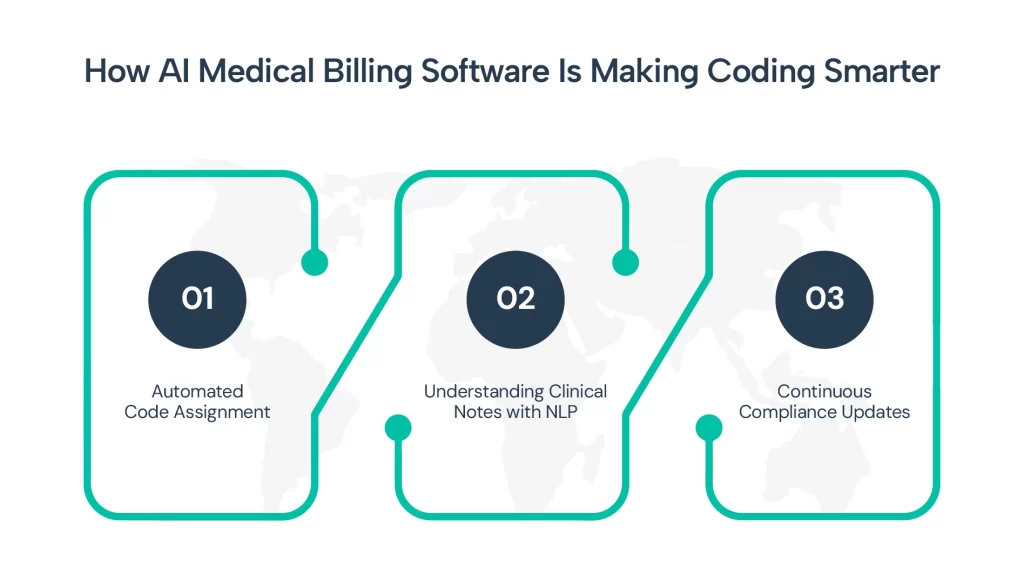
How AI Medical Billing Software Is Making Coding Smarter
AI software is modernizing medical coding by reading and interpreting clinical notes faster than humans. It identifies procedures and diagnoses, maps them to the correct codes, and keeps up with the latest payer rules. To see how AI makes coding smarter and more efficient, we can look at the key ways it works in practice.
Automated Code Assignment
AI has transformed coding from a manual process into a smart, data-driven operation. It scans clinical notes, identifies procedures and diagnoses, and maps them to the correct billing codes. By recognizing patterns in patient records, the system suggests the most accurate codes without requiring staff to go through every detail manually.
Understanding Clinical Notes with NLP
Natural Language Processing (NLP) allows AI to read unstructured medical notes and turn them into structured data. It extracts key terms and links them to appropriate codes. For example, symptoms like “shortness of breath” and “chest discomfort” are matched automatically to the correct ICD-10 codes, saving time and reducing errors.
Continuous Compliance Updates
AI software stays updated with the latest coding rules and payer policies. When regulations change, the software flags outdated codes and suggests replacements. This real-time adjustment ensures that coding remains compliant without requiring manual updates or research.
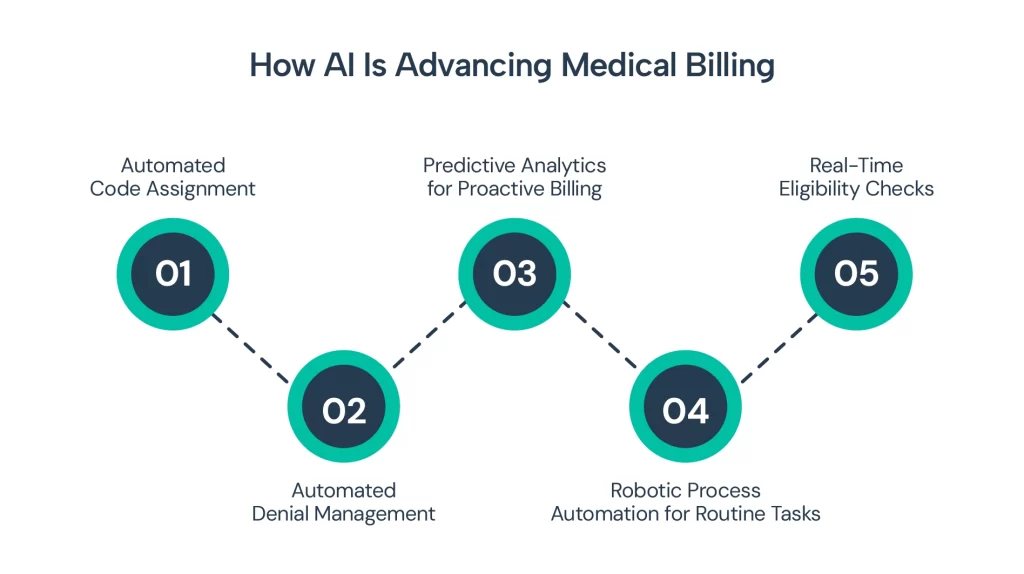
How AI Is Advancing Medical Billing
When it comes to managing healthcare finances, medical billing has always been one of the most time-consuming and error-prone parts of the process. For years, billing teams spent hours entering charges, checking claims, and chasing reimbursements. That’s changing rapidly with the rise of AI medical billing software, which is redefining how providers handle payments, claims, and overall revenue.
1: Claim Scrubbing and Verification
AI reviews every claim before it is sent to insurers. It checks for missing information, mismatched codes, or formatting issues and corrects them immediately. This proactive approach ensures that most claims are clean when submitted, reducing denials and rework.
2: Automated Denial Management
When claims are denied, AI studies the reason and generates appeal letters automatically. It organizes denials by cause and prioritizes them, allowing staff to focus on complex cases while routine issues are resolved by the system.
3: Predictive Analytics for Proactive Billing
AI analyzes past claims to identify patterns that lead to denials or late payments. It alerts billing teams to high-risk claims before submission, allowing corrections in advance. This turns billing from reactive problem-solving into proactive revenue protection.
4: Robotic Process Automation for Routine Tasks
RPA bots handle repetitive work like entering patient data, updating claim information, and uploading submissions. These bots operate continuously, reducing staff workload and minimizing errors caused by fatigue or oversight.
5: Real-Time Eligibility Checks
Before billing, AI verifies patient insurance coverage. This prevents claims from being rejected due to eligibility issues and ensures patients receive accurate billing information upfront.
Benefits of AI in Billing and Coding
Here’s how AI is helping healthcare teams handle billing and coding more effectively.
1: Improved Accuracy
AI minimizes human errors by processing large volumes of data consistently. Under-coding and over-coding are reduced, resulting in cleaner claims and faster reimbursements.
2: Greater Efficiency
By handling repetitive tasks, AI frees staff to focus on complex cases and patient communication. Higher claim volumes can be managed without adding more employees.
3: Faster Reimbursements and Revenue Stability
With fewer denials and streamlined processing, payments arrive faster. Predictive insights help maintain steady cash flow, allowing organizations to reinvest in patient care and technology.
4: Continuous Compliance
AI monitors coding standards, payer rules, and documentation requirements in real time. Inconsistencies are flagged before claims are submitted, reducing audit risk and penalties.
5: Flexibility Through the Cloud
When integrated with cloud-based medical billing software, AI allows teams to access dashboards, track claim statuses, and monitor performance from anywhere. This improves collaboration and transparency across departments.
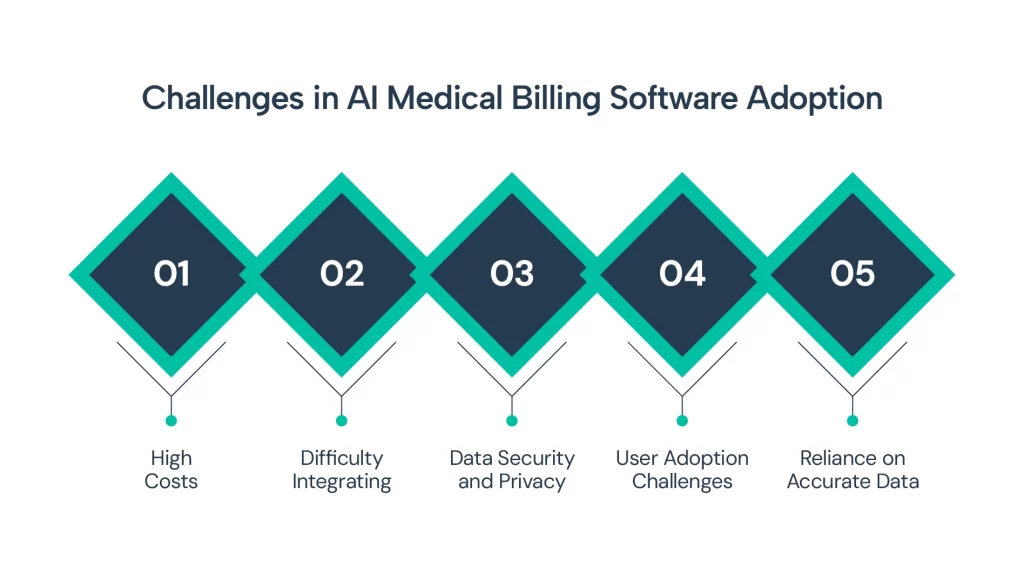
Challenges in Adopting AI Medical Billing Software
While AI medical billing software brings many benefits, adopting it comes with hurdles.
1: High Costs
One major challenge is cost. Implementing AI requires investment in software, hardware, and integration with existing systems. Billing and insurance-related expenses already make up a large part of healthcare administration in the U.S., with at least 62% of costs tied to billing and insurance. Smaller practices may find these upfront expenses difficult to manage.
2: Difficulty Integrating
Integration with existing systems can also be difficult. AI must connect properly with multiple software platforms, databases, and older systems. If connections are not handled well, it can cause data errors, slow processing, or incomplete automation, which affects overall performance.
3: Data Security and Privacy
Data privacy and security are another concern. Handling sensitive patient information requires strict compliance with HIPAA and other regulations. AI systems need strong encryption and controlled access, and staff must be trained to handle data carefully to avoid exposure risks.
4: User Adoption Challenges
Staff adjustment is also challenging. Employees may feel uncertain or worry about job changes. Proper training helps teams understand how to work alongside AI, interpret its suggestions, and manage tasks that require human judgment.
5: Reliance on Accurate Data
Finally, AI depends on accurate historical data. Incomplete or biased data can cause mistakes. Continuous monitoring and human oversight are essential to ensure the system remains reliable and accurate.
What Comes Next?
AI medical billing software is growing, and we can expect it to become even smarter. Soon, it will learn faster from past claims and adapt to new payer rules on its own. This will let staff focus more on complicated cases and patient care instead of routine work.
With technological developments, automation will go further, helping predict revenue trends, spot problems before they happen, and give clear insights for better financial decisions. Dashboards will show claim status, denials, and performance in real time, making it easier to manage billing from anywhere.
As AI tools become more affordable and cloud-based medical billing software spreads, even small practices will benefit. The future will be about AI and humans working together to make billing faster, more accurate, and less stressful.
Frequently Asked Questions
Medical billing software is a digital tool that automates the billing process for healthcare providers, including claim creation, coding, insurance verification, and payment tracking.
It follows the revenue cycle management process, from patient registration and coding to claim submission, payment posting, and reporting, often using AI and automation to reduce errors.
Yes, most solutions integrate with EHR/EMR systems, clearinghouses, and analytics platforms to improve workflows and maintain accurate patient and financial data.
Absolutely, Small businesses and billing companies can automate repetitive tasks, manage claims efficiently, and scale operations without increasing staff or costs.
Yes, it uses encryption, access controls, and audit trails to protect patient data and meet HIPAA requirements.